Why Adult Halloween Parties Are Trading Candy for Halloween Embroidery Patches
It’s 10:40 p.m. The playlist has already gone around twice, nobody is ready to leave, and the host taps a spoon against a glass.
“Patch check.”
The people who came last year know what happens next. They reach into pockets, purses, denim jackets, and costumes that somehow have pockets, and put an embroidered patch on the table.
Some are from last year’s party. One came from a haunted house in another state. Another has been sewn onto the same jacket for three years.
The four people who came without one owe the group a round.
That’s the whole game. It takes about ninety seconds to explain.
This is the kind of small ritual that is starting to show up at adult Halloween parties. And it says something about how the holiday has changed.
Halloween is no longer just a night for children to collect candy. For adults, it has become a social event: costumes, decorations, themed parties, elaborate food and drinks, group photos, and, increasingly, something tangible to take home.
That something doesn’t have to be another plastic favor.
It can be a patch
The Adult Halloween Economy
Look beyond the candy.
Halloween spending in the U.S. has remained substantial in recent years, with adults increasingly spending on costumes, decorations, parties and seasonal experiences.
The more useful point for party hosts is not the exact size of the market, but how Halloween has become a more intentional social occasion for adults.
For many adults, Halloween now involves more than a costume and a bowl of candy. Parties, themed gatherings, decorations, food, drinks, and shared experiences all play a larger role in how the holiday is celebrated.
That changes what people expect from a Halloween party.
A costume is no longer enough. Hosts are building an entire experience around the night, and guests increasingly expect something more memorable than a bowl of candy by the door.
That creates a familiar problem for party hosts: what do you actually give people?
Candy disappears. Plastic novelty items end up in drawers. Temporary tattoos last until the shower.
A well-made patch can last until next Halloween—and the one after that.
Why the Patch Works
There is a practical reason patches make good party favors: they don’t need a size.
A hoodie needs a size spreadsheet. A T-shirt creates leftovers. A mug takes up space. A food gift gets consumed.
A patch goes into an envelope and works for almost everyone.
More importantly, it becomes part of something.
Put one on a denim jacket and it becomes part of the jacket. Put one on a canvas tote and it becomes part of the bag. Keep a series from different years and it becomes a record of the parties you’ve attended.
That gives an embroidered patch something most party favors don’t have: a reason to survive.
The point isn’t that every Halloween party needs a patch.
It’s that, for a themed or annual event, a patch can do something a disposable favor can’t: give the night a physical identity.
What Adult Halloween Patches Actually Look Like
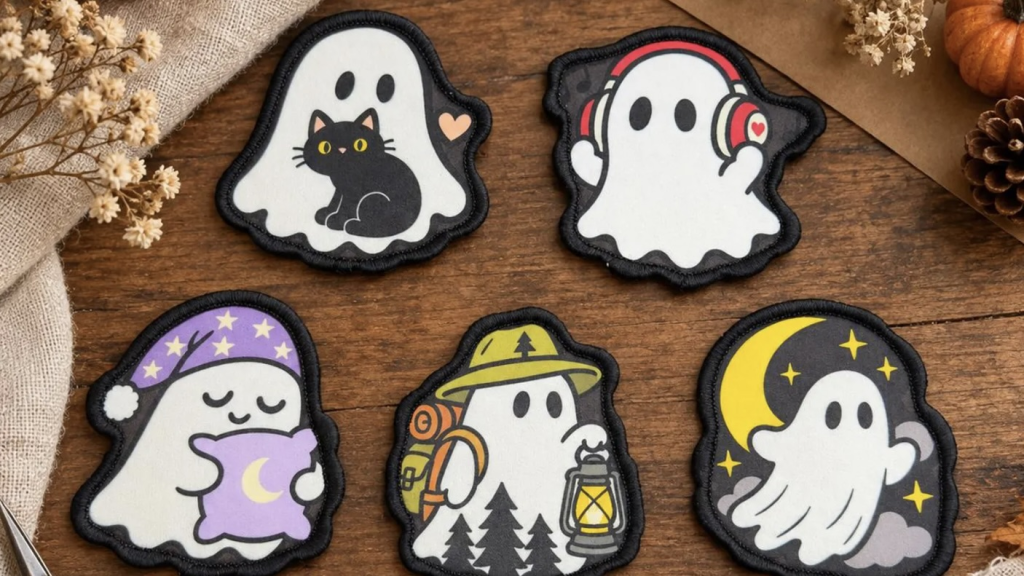
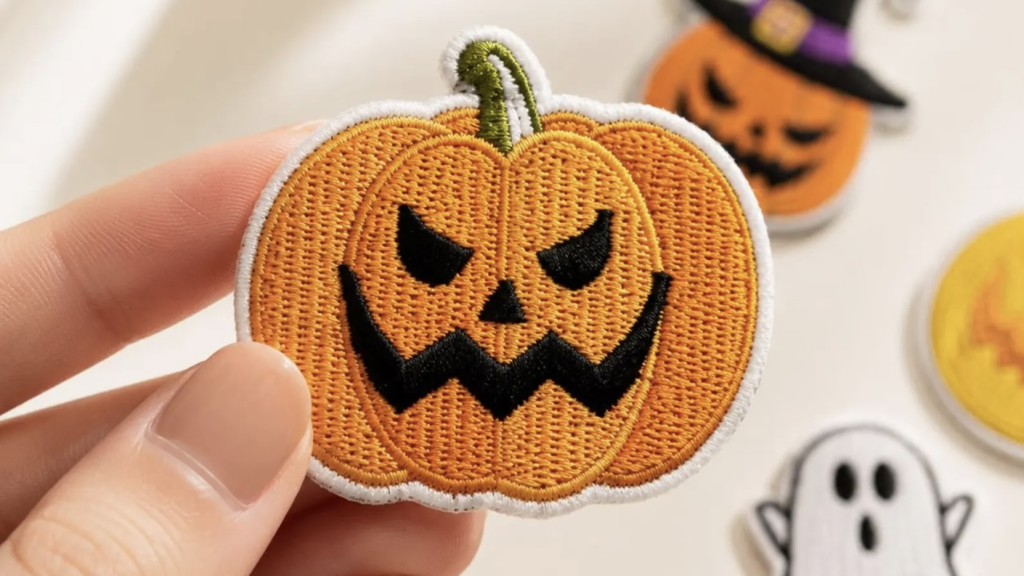
Walk through the Halloween aisle of a department store and you’ll see plenty of pumpkins, ghosts, and cartoon black cats.
Adult patch design tends to go somewhere else.
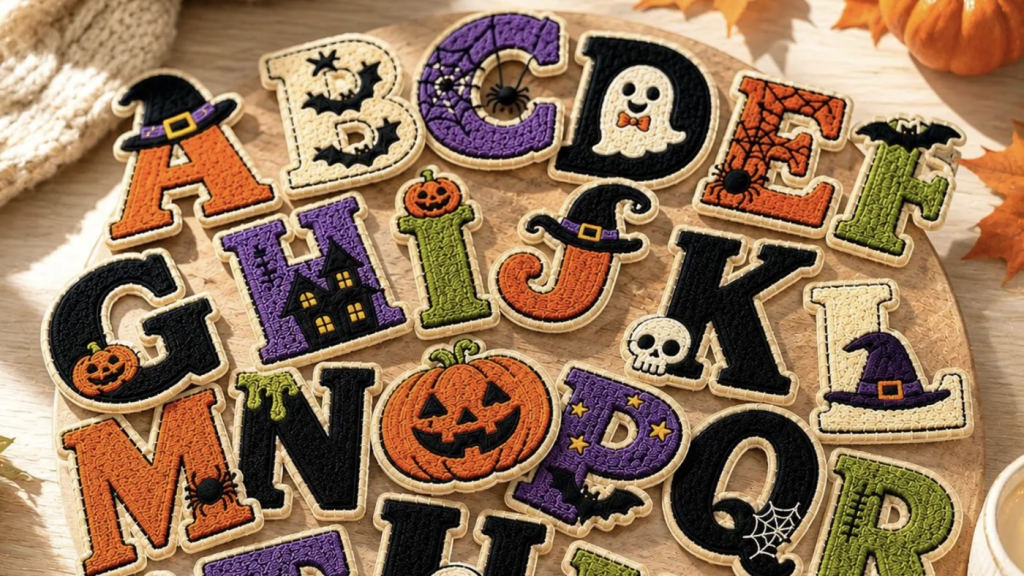
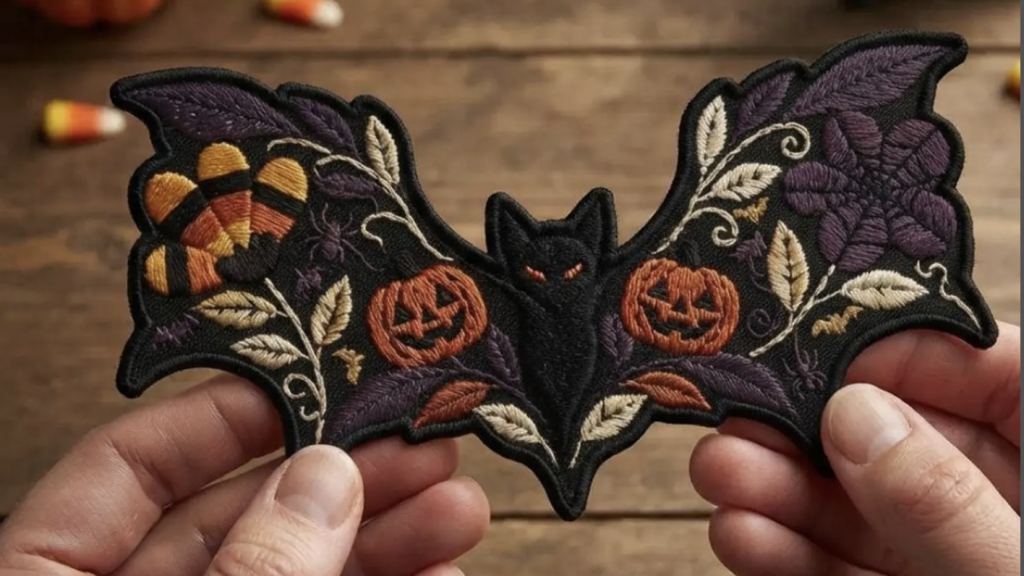
Think vintage chenille witches, gothic lettering, grim reapers, ravens, haunted houses, black cats, old-school skulls, or a small Halloween symbol with a surprisingly detailed finish.
The best designs often look as though they could have come from a vintage shop or tattoo studio rather than a party-supply aisle.
There are a few directions that work particularly well:
The design doesn’t need to be complicated.
In fact, the strongest patch is often the one with one clear idea.
A black cat with glowing eyes.
A haunted house with the year underneath.
A vintage Halloween emblem with the name of the party.
One symbol, done well, is usually more wearable than six Halloween elements fighting for space.
Five Ways to Use a Patch at the Party
A patch doesn’t have to be handed out as guests walk through the door.
There are better ways to make it part of the event.
1.The invitation patch
Send the patch with the invitation. It immediately tells guests that this isn’t just another costume party.
2.The door patch
Give everyone a dated patch when they arrive. If the party happens every year, the design becomes the physical marker of that year’s event.
3.The patch check
Ask guests to bring patches from previous years. Put them on the table, compare designs, and let people tell the stories behind them.
That’s how a favor turns into a tradition.
4.The costume prize
Instead of a generic trophy, make a patch for categories such as Best Costume, Best Group Costume, Scariest, or Best Last-Minute Costume.
5.The annual series
This is where things get interesting.
Make 100 numbered patches for 2026. Create a different design for 2027. Keep the same basic visual language, but change the symbol, color, or theme each year.
Someone who gets 003/100 this year has a reason to come back next year.
The party now has a collection.
Six Design Rules That Matter
If you’re ordering custom patches for an adult Halloween event, the small decisions matter.
1.Put the year on it.
A patch marked “2026” immediately becomes a record of the event. Without the year, the same design can look like generic Halloween merchandise.
2.Keep it around 2–2.5 inches.
Small enough to wear on a jacket or bag, but large enough for the design to remain readable. Go much smaller and details disappear. Go much larger and the patch becomes heavier and more expensive.
3.Use specialty effects selectively.
Glow-in-the-dark thread works well for eyes, moons, stars, or lettering. Metallic thread can highlight a border or small detail. Covering the entire patch in special effects usually makes the design look busier, not better.
4.Pick one visual direction.
Vintage, gothic, cute, horror, fall-themed—choose one. A patch trying to do all of them usually ends up looking like clip art.
5.Match the backing to the use.
Iron-on works well for quick application. Sew-on is better for heavy denim and jackets. Hook-and-loop makes sense for costumes where the patch needs to be swapped.
6.Give it a card.
A patch in a plastic bag looks like a product.
A patch mounted on a small card that says “Halloween 2026” or includes the name of the party feels like a keepsake.
The card adds another layer of presentation and changes how the item is received.
The Forty-Day Problem
Here’s the part party hosts tend to discover too late.
Halloween is October 31, and custom embroidered patches can take four to six weeks once artwork, digitizing, sampling, production, and shipping are included.
If you’re planning in late September, you’re already close to the comfortable ordering window.
Rush production can shorten the timeline, and some simpler orders can ship within five to seven days. But the tradeoffs are real: fewer customization options, higher shipping costs, and less room for mistakes.
A simple timeline looks like this:
Don’t leave the design decision until the last minute.
The most expensive part of a rush order isn’t always the patch. It’s realizing that the patch you actually wanted can no longer be produced on time.
The Part People Keep
A Halloween party eventually disappears.
The decorations come down. The costume goes back into the closet. The food is gone. The photos sit somewhere in a camera roll.
The patch is different.
It can stay on a jacket for the next eleven months. Then September comes around again, someone sees it, and asks:
“What’s the theme this year?”
That’s a small thing, but it’s also how traditions start.
Adult Halloween has become more elaborate, more social, and more intentional. The party itself may only last one night. A good keepsake can last much longer.
And for a host looking for something guests will actually wear, trade, and keep, an embroidered patch may be a better choice than another piece of disposable party swag.
Design Category | Examples | Best For | |
Classic Halloween | Pumpkins, bats, ghosts, skulls | General parties | |
Vintage | Chenille, retro lettering, 1950s motifs | Nostalgia-focused events | |
Horror & gothic | Grim reapers, ravens, haunted houses | Horror fans, alternative fashion | |
Cute but grown-up | Spooky cocktails, black florals, playful pumpkins | Casual adult parties | |
Pet-themed | Black cats, pumpkin-wearing dogs | Pet owners | |
Specialty | Glow thread, metallic thread, 3D details | Collectors and themed events | |
When | What to do | ||
5–6 weeks out | Finalize the concept and quantity | ||
4–5 weeks out | Approve artwork and digitizing | ||
4 weeks out | Place the production order | ||
2 weeks out | Check the shipment and prepare distribution | ||
Halloween week | Hand them out, run the patch check, take photos | ||
FAQ About Custom Halloween Embroidered Patches
Why are embroidered patches a good choice for adult Halloween parties?
They are compact, wearable, and easy to personalize. Unlike many disposable party favors, a patch can become part of a jacket, bag, costume, or collection and continue to be used after the event.
What designs work well for adult Halloween patches?
Gothic lettering, vintage Halloween graphics, haunted houses, ravens, skulls, black cats, witches, and understated seasonal symbols all work well. The strongest designs usually focus on one clear visual idea rather than combining too many elements.
Should a Halloween patch include the event year?
Adding the year can make a patch feel more like a keepsake and helps distinguish one edition from another. This is particularly useful for annual parties, festivals, clubs, and recurring events.
Which backing should I choose for a custom Halloween patch?
Iron-on backing is convenient for quick application, while sew-on backing is useful for jackets and heavier fabrics. Hook-and-loop backing can work well for costumes or situations where the patch needs to be removed and changed.
How far in advance should I order custom Halloween patches?
It is best to plan several weeks ahead. The exact production time depends on the artwork, digitizing, quantity, sampling, production, and shipping. Starting early leaves more room for revisions and avoids unnecessary rush production.