Table of Contents
Trick, Treat, and Metal: Why Halloween Challenge Coins Are 2026's Newest Tradition
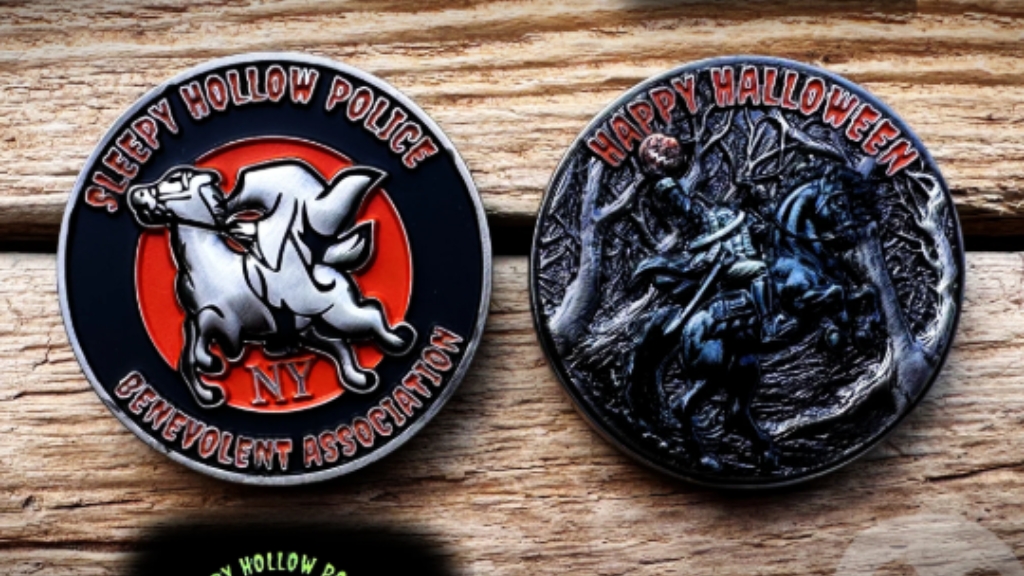
Somewhere around 7:40 p.m. on the last Saturday of October, a kid in a dinosaur costume is going to reach into a plastic pumpkin bowl on a stranger’s porch and pull out something unexpected. Not a fun-size bar. Not a glow stick. A two-inch disc of solid metal, cool and heavier than it looks, with a jack-o’-lantern grinning back at them in raised antique copper.
They will not know what it is. They will know immediately that it is better than what was in the last bowl.
That moment is about to happen in a lot of neighborhoods this year, because Halloween 2026 has lined up almost too perfectly. October 31 falls on a Saturday — the single best night of the week the holiday can land on — and U.S. Halloween spending is projected to hit a record 13.1 billion**, with **73% of consumers** planning to celebrate and per-person spend climbing to roughly **114.45. Costumes will take 4.3 billion, decorations 4.2 billion, candy 3.9 billion, and pet costumes another 860 million.
But the number that matters most for anyone making anything is this one: decorations have overtaken costumes as the most-purchased Halloween category, with 78% of shoppers buying them. Halloween has quietly stopped being a candy holiday and become a stuff holiday — a holiday about objects, keepsakes, and the props people use to build one night they’ll remember. And nothing in the holiday’s current trajectory fits that shift better than a challenge coin.
A Saturday Halloween Changes the Math
Start with the calendar, because a weekend Halloween is not a minor detail.
When October 31 lands on a Saturday, participation doesn’t just rise — it stretches. Trick-or-treating runs later into the evening because nobody has school or work the next morning. Parties move from Friday to Saturday and run longer. Trunk-or-treat events, which churches and schools schedule on weekends by default, get a full-day runway instead of a two-hour Wednesday slot. Analysts estimate a Saturday Halloween lifts decoration, costume-accessory, and party-supply sales by 12 to 18 percent compared with a weekday holiday.
That extra volume is why 2026 is being forecast as a record rather than a repeat. It also explains something that’s been building for years: the season starts earlier every year, and it is no longer subtle about it.
Nearly half of shoppers — 49% — now begin buying Halloween items in September or earlier, up from 47% in 2024 and just 32% a decade ago. Activity starts climbing around August 25 and peaks the week of September 30, with roughly 60% of orders placed before October begins. Google Trends put the search score for “Halloween 2026” at 100 in July — already above the previous October peak. On Etsy, “halloween gift” hit 1.9 million monthly searches, up 68.4% in three months. TikTok and Pinterest have given the early-season obsession a name: Summerween.
Read that last figure again: halloween gift. Halloween has crossed over from a night of consumption into an occasion where people buy things for each other. That is precisely the psychological territory where challenge coins live.
The Candy Problem Nobody Talks About
Here is the part of the Halloween economy that doesn’t show up in the retail forecasts.
According to FARE (Food Allergy Research & Education), 1 in 13 children in the U.S. has at least one food allergy — roughly 5.6 million kids. For those families, the bowl on the porch isn’t a treat; it’s a hazard, or at minimum an evening spent reading labels in the cold while everyone else moves on. A study published in Pediatric Allergy and Immunology found that 42% of families with food-allergic children avoided door-to-door trick-or-treating entirely because of the risk of accidental exposure.
The response has been the Teal Pumpkin Project, FARE’s initiative encouraging households to put a teal pumpkin on the porch as a signal that non-food treats are available. It started in 2014 with about 800 registered homes. By 2021, more than 15,600 households across all 50 states and Washington, D.C. had placed themselves on the map — and the sight of a teal pumpkin on a porch has since become unremarkable in a lot of neighborhoods.
That created an obvious question: if not candy, then what?
For years the answer has been a rotation of small plastic novelties — spider rings, erasers, bouncy balls, temporary tattoos. They work, in the sense that they’re safe and cheap. But parents who have actually run a teal-pumpkin bowl know the uncomfortable truth: most non-food treats feel like what they are — a substitute. Kids can tell. The most successful givers have learned that the item has to be cool, not a consolation prize.
This is the gap a challenge coin fills perfectly.
| Candy | Plastic novelty | Halloween coin |
Allergen-safe | No — top 9 allergens common | Usually yes | Yes — inert metal |
Shelf life | One night (or one week of parental rationing) | Days to weeks | Years |
Perceived value | Low per unit | Low per unit | High — weight reads as premium |
Kept or discarded | Eaten | Lost in a bedroom | Kept, displayed, collected |
Return rate next year | Zero | Low | Kids come back asking |
Cost per unit | 0.15–0.60 | 0.20–0.80 | 2–6 (bulk, simple design) |
Year-over-year story | None | None | Numbered editions, dated variants, sets |
The economics are more favorable than the sticker price suggests. Candy is consumed and forgotten — you buy it again next year, at a higher price, and get nothing back. A coin is a one-time acquisition that gets remembered, photographed, and — critically — asked about. Parents who hand out coins report the same thing year after year: the house becomes a landmark. Kids route back to it.
Why a Coin, and Not Just Another Toy
The reason a coin outperforms a plastic spider ring isn’t weight or shine. It’s the rule attached to it.
Challenge coins come from a military tradition with one non-negotiable principle: a coin is earned, never bought. You receive it from someone who saw what you did. Carrying it is proof you belong. And if someone calls a “coin check,” you’d better have it on you.
Halloween is a near-perfect civilian match for that logic. It’s a one-night event with a hard deadline, built around costumes, thresholds, and a small set of rituals everyone recognizes — and it already has a vocabulary of earning: you walked the whole route, you made it through the haunted house, you showed up in the group costume. Hand a kid a coin at the end of a hayride and you aren’t giving out a party favor. You’re marking something they did.
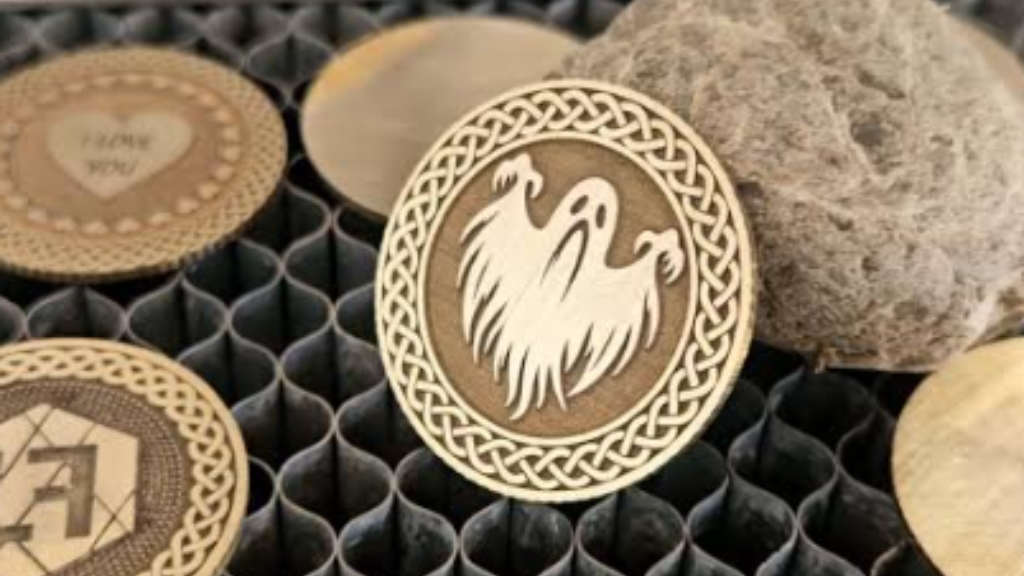
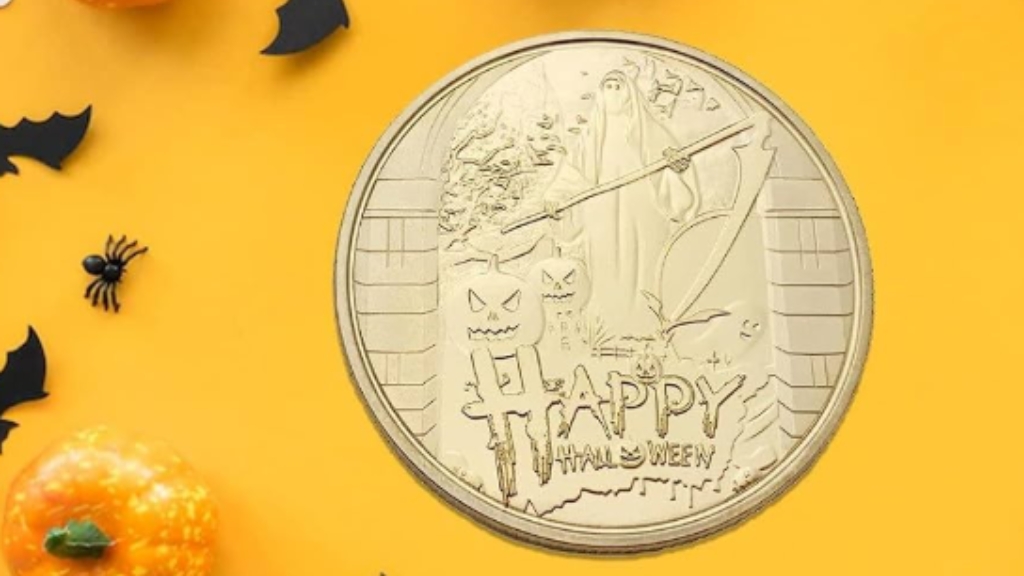
It also helps that the coin’s visual language already overlaps with Halloween’s: skulls, ravens, black cats, crescent moons, cryptids, gothic type, and above all glow-in-the-dark — simultaneously the holiday’s signature effect and the most-requested finish in custom coin design right now.
Where the Coins Are Already Showing Up
This isn’t theoretical. Coins have been spreading through the Halloween economy for several seasons, and 2026 is the year the pattern becomes visible.
Trunk-or-treat events. Churches, schools, and HOAs are now the default venue for a large share of American families, and they’re chronically short of giveaways that feel worthwhile. A coin with the organization’s name and the year turns a parking-lot event into an annual one — and gives the organizer a reason to reorder every October.
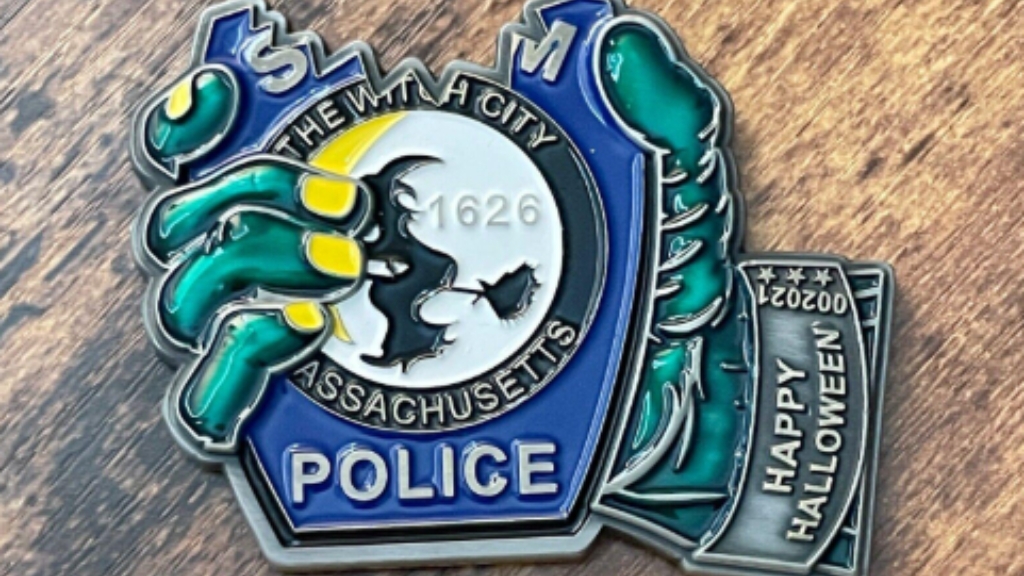
Fire and police safety nights. Departments have handed out plastic badges and reflective stickers for decades. A coin is smaller, lasts longer, and carries the department’s identity into a kid’s bedroom. Some now pair it with a reflective element for visibility on a dark street — solving a safety problem and a branding problem at once.
Haunted attractions and hayrides. Operators are under constant pressure to raise per-head revenue without raising ticket prices. A coin sold as an add-on — or bundled into a VIP tier — is the cleanest upsell in the industry: low unit cost, high perceived value, and every visitor leaves as walking advertising. Numbered runs (001/500) create the urgency a merch table otherwise can’t manufacture.
Craft breweries and taprooms. Halloween is already a major release window for seasonal beer, and breweries have seen what enamel pins did for their regulars. A limited coin — glow enamel, numbered, maybe doubling as a bottle opener — moves at the taproom and keeps the brand on a shelf all year.
Libraries, schools, and reading programs. An October reading challenge that ends in a coin instead of a certificate gets finished. Tangible, durable, and slightly prestigious beats a piece of paper every time.
Families and friend groups. The smallest and fastest-growing segment: matching coins for a group costume, a family coin mailed to relatives ahead of the night, a “first Halloween” coin for a baby. Small runs, high emotional weight, extremely shareable.
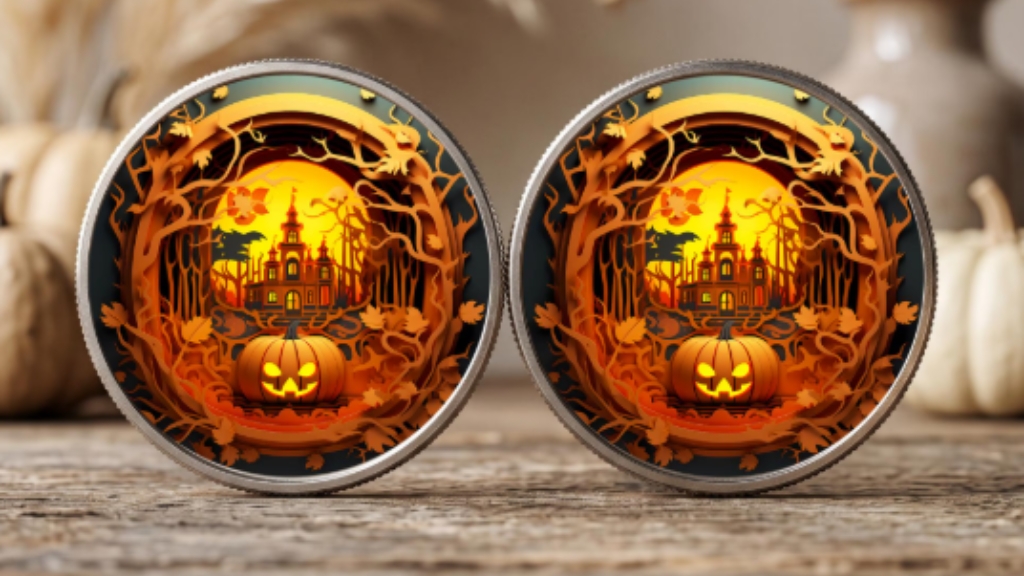
What a Halloween Coin Should Actually Look Like
The single biggest mistake first-time buyers make is treating a Halloween coin like a Christmas ornament: bright, flat, novelty-grade. The coins that get kept are the ones that look like they cost more than they did.
Design choice | Why it works for Halloween | Notes |
Glow-in-the-dark enamel | The holiday’s signature effect; reads in photos and in the dark | Use it selectively — eyes, moon, lettering — not the whole face |
Antique or matte black plating | Gothic, premium, avoids “cheap giveaway” | Matte black with antique copper highlights is 2026’s strongest combo |
Deep 3D relief | Skulls, ravens, haunted houses need sculpting, not flat color | Deep-relief minting is the breakout premium format of the last two seasons |
Dual plating | Two-tone metal creates depth without extra color | Silver + black nickel is the safest pairing |
Numbered edge | Scarcity drives the “come back next year” loop | e.g., 031/250 — the number itself becomes the story |
Functional edge | Bottle opener or spinning element | Highest perceived value per dollar; strong for breweries and adult events |
NFC or QR chip | Tap to load a video, a map, or a coupon | Best for attractions and brands measuring foot traffic |
Two practical notes. First, if you’re ordering for a trunk-or-treat or a neighborhood handout, keep the design simple and the size at 1.5–1.75 inches — these coins go into pockets and pillowcases, and anything larger gets bulky in a bulk order. Second, glow enamel and matte finishes are the two options most likely to be out of stock in October. If either is on your list, order before the rush, not during it.
The Real Deadline: Six Weeks, Not Six Days
Here’s the uncomfortable part. It is mid-September. Halloween is Saturday, October 31 — roughly six and a half weeks away — and standard production for custom coins runs four to six weeks including artwork, molding, production, and shipping.
The comfortable ordering window closes around the end of this month. After that you’re into express territory: UV-printed coins ship in as little as 1–3 days of production, a genuine lifeline for anyone who discovers on October 20 that their trunk-or-treat has 300 kids and 40 giveaways. But express production limits your finish options, and air freight on a rush order can cost more than the coins.
A realistic runway, anchored to October 31:
When | What to do |
Now (6+ weeks out) | Lock the concept and quantity. Decide whether this is a one-year handout or year one of an annual numbered series — the answer changes your design. |
5 weeks out | Request artwork. Most custom coin suppliers provide free design proofs; budget two revision rounds. |
4 weeks out | Approve the final design and place the order. Confirm the mold fee is one-time so next year’s dated variant reuses it. |
2 weeks out | Coins arrive. If it’s a numbered edition, display the low numbers — people who see 001–050 already claimed will remember that next October. |
Halloween week | Distribute, and photograph it. The single best marketing asset for your 2027 coin is a photo of a kid holding this year’s. |
One more note for anyone selling rather than giving: 79% of Halloween shoppers expect to pay more this year, largely because of tariffs. That’s not a reason to hold your price down. When four out of five customers arrive already expecting higher prices, a well-made object at a fair price reads as value, not as expensive.
The Bowl Nobody Forgets
Think about what happens to Halloween stuff. The costume is worn once and outgrown. The candy is gone by November 3. The decorations come down the first weekend of November and go into a bin in the garage. Almost the entire $13.1 billion is, by design, disposable.
A coin is the one object in the season that survives it. It ends up in a pocket, then on a nightstand, then in a drawer that slowly becomes a collection. Next October the kid who got one asks where it is. The house that handed it out gets a second visit before the first doorbell rings. The attraction that sold 250 numbered coins finds people bought tickets this year specifically to complete a set.
Traditions don’t start with a marketing plan. They start with one object that felt worth keeping, handed to someone on a night built for remembering. Halloween has spent a decade becoming America’s favorite night to dress up. In 2026, it’s quietly becoming a night to collect something, too.
Six weeks is enough time to mint the first one.