Table of Contents
The Caregiver's Coin: Honoring Nurses and Medical Teams with Challenge Coins
It’s 3 a.m. on a med-surg floor. The nurse has been on her feet for nine hours, skipped her break twice, and just spent twenty minutes holding the hand of a patient who was scared to be alone. Nobody saw it. Nobody logged it. There’s no form for the moments that don’t produce a diagnosis — only the ones that produce a difference.
This is the reality of modern healthcare, and it’s exactly why a quiet military tradition is taking root in hospitals and nursing schools across America. Challenge coins — the pocket-sized metal tokens soldiers have exchanged for a century to mark service and sacrifice — have found a new home in scrubs.
This article explores how challenge coins moved from the barracks to the bedside, why nurses and medical teams value them more than certificates or plaques, what 2026 design trends look like, and how healthcare organizations can start their own coin traditions.
From the Barracks to the Bedside
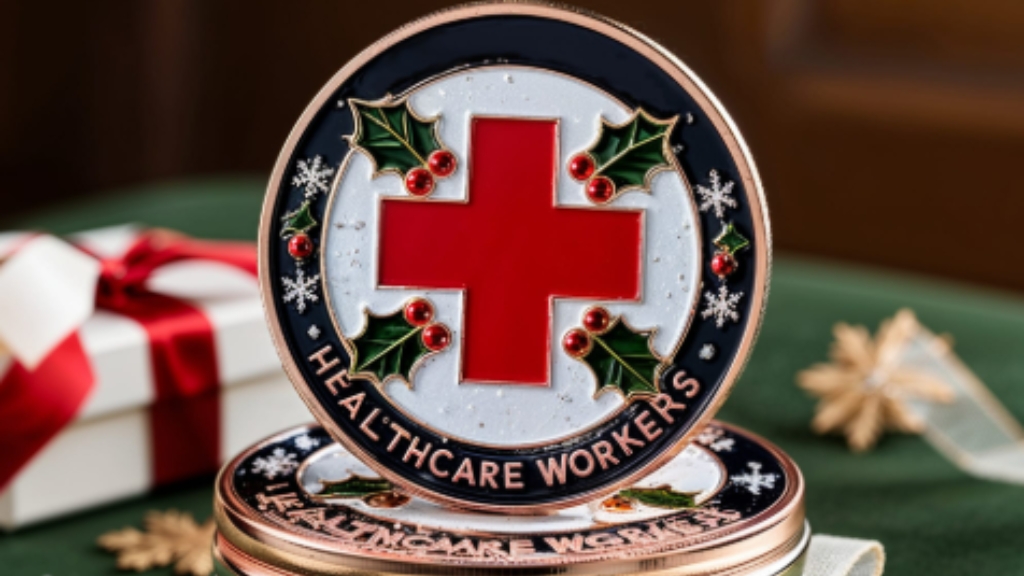
The challenge coin tradition dates to World War I, when an aviation lieutenant commissioned bronze medallions for his squadron. The legend: a downed airman used his coin to prove his identity to French soldiers and escape execution. Whether true or not, the tradition it seeded is real — military units began striking coins to mark membership, build morale, and bond people who face danger together.
Healthcare borrowed the tradition for the same reasons. Veterans who became nurses and hospital administrators carried it with them — Kaiser Permanente still presents coins to staff on Veterans Day. But the tradition has outgrown its veteran-to-veteran pipeline: in 2026, health systems use coins for new-grad orientation, resident match days, nursing week, retirement, and memorials. Cooper University Health Care in New Jersey has run a “Kindness Coin” program for five years, with team members passing coins to colleagues caught doing small acts of compassion.
Why did the tradition transplant so cleanly? Because nursing shares the military’s core conditions: high-stakes responsibility, intense team interdependence, exposure to trauma, and a culture that values quiet competence over self-promotion. A coin weighs almost nothing. What it represents weighs everything.
Why Coins Beat Certificates in Healthcare
Recognition in healthcare is notoriously difficult. Supervisors rarely witness the moments that matter most — the 3 a.m. hand-holding, the de-escalated angry family, the code that went smoothly because a nurse anticipated it five minutes early. Paper certificates can’t capture those moments. Coins can.
The data explains why this matters. The 2026 NSI National Health Care Retention & RN Staffing Report found national RN turnover hit 17.6% — up from 16.4% in 2024, with some hospitals losing 40% of staff annually — and the country is projected to be short roughly 264,000 registered nurses. Recognition is consistently a top driver of job satisfaction — not annual awards, but daily acknowledgment from leadership and peers — and 31.5% of nurses who left cited burnout as the reason. Recognition won’t fix understaffing, but it changes how nurses experience the work.
Challenge coins fill a gap no other recognition tool fills. They serve four functions in healthcare culture:
- Tangible proof of intangible work.A coin has weight and permanence. When a charge nurse presses one into a new graduate’s palm after a difficult shift, the gesture outweighs an email from HR. It becomes a physical anchor for a memory: you did the hard thing, and someone noticed.
- Unit identity on floors that turn over.With 22.7% of newly hired RNs leaving within their first year, hospital floors are among the highest-turnover workplaces in America. A floor-specific coin — ICU, ER, oncology, NICU — says you belong herein a way a badge doesn’t.
- Peer-to-peer recognition.Not every coin comes from leadership. The peer exchange — an ICU nurse handing a coin to a colleague after a brutal shift — carries the deepest meaning, because it comes from someone who knows exactly what the moment cost.
- Commemoration and remembrance.Memorial coins honor colleagues lost to illness or the weight of the work itself, giving families and coworkers something physical to hold when words fail.
The Language of Healthcare Coins: Symbols and Meanings
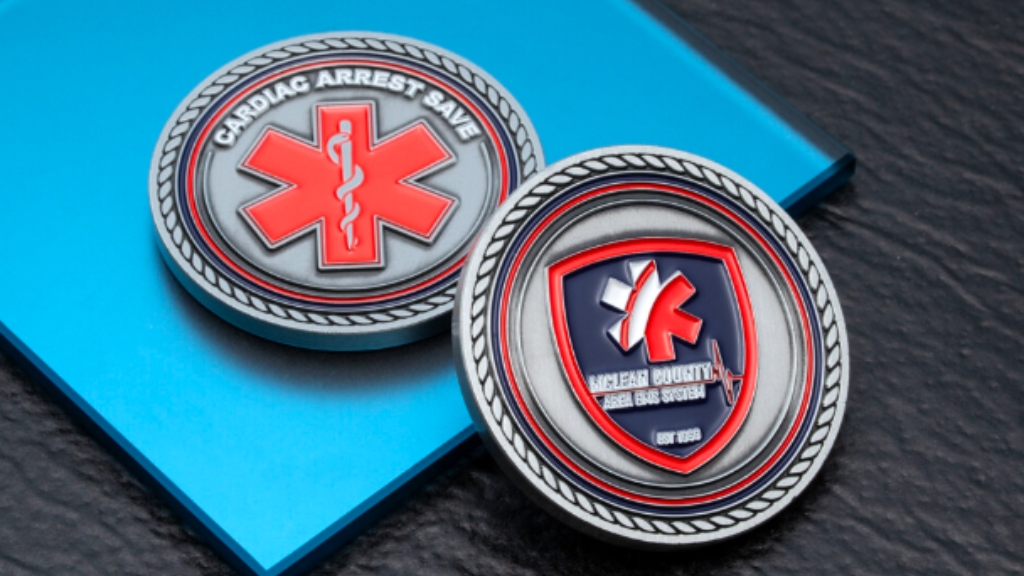
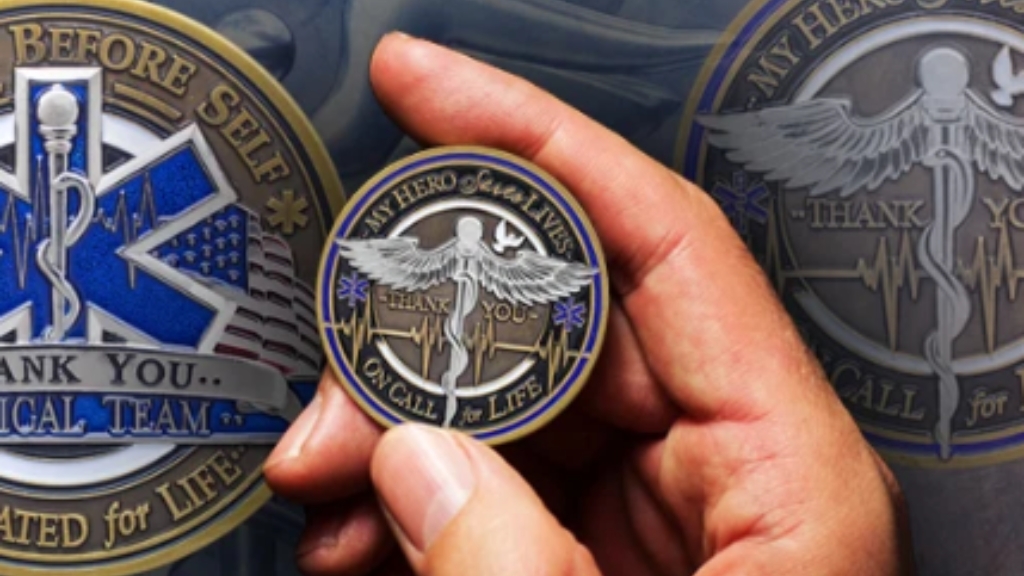
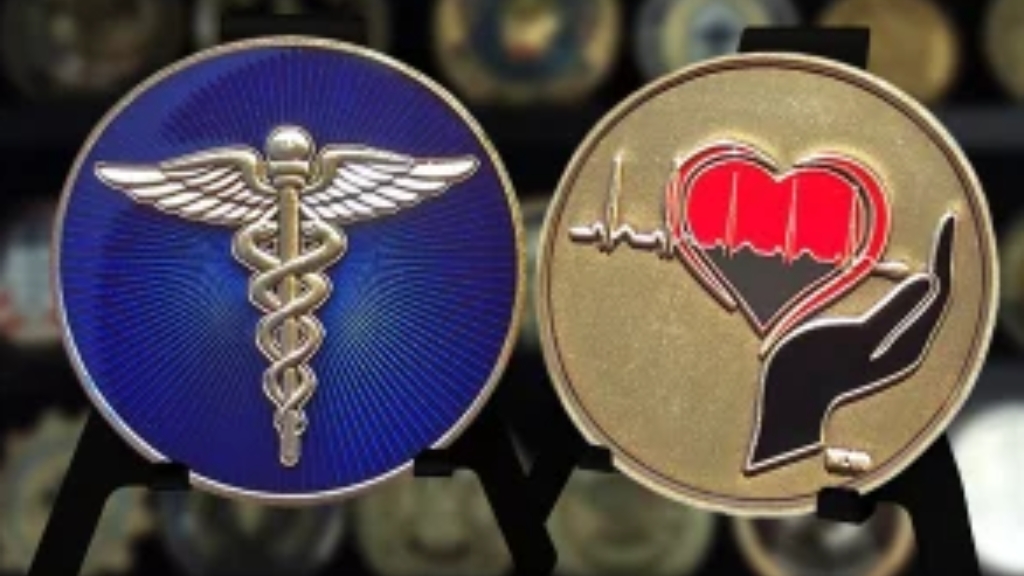
Medical challenge coins speak a visual language caregivers read instantly. Choosing the right symbols is the difference between a coin that gets carried and one that gets lost in a drawer.
Symbol | Meaning | Common Use |
Florence Nightingale Lamp | Founder of modern nursing’s lantern; care and compassion | Graduation and pinning ceremonies |
Rod of Asclepius | Single serpent and staff; authentic symbol of medicine | Medical teams, hospital coins |
Caduceus | Winged staff, two serpents; widely used in medical branding | Commercial medical marks |
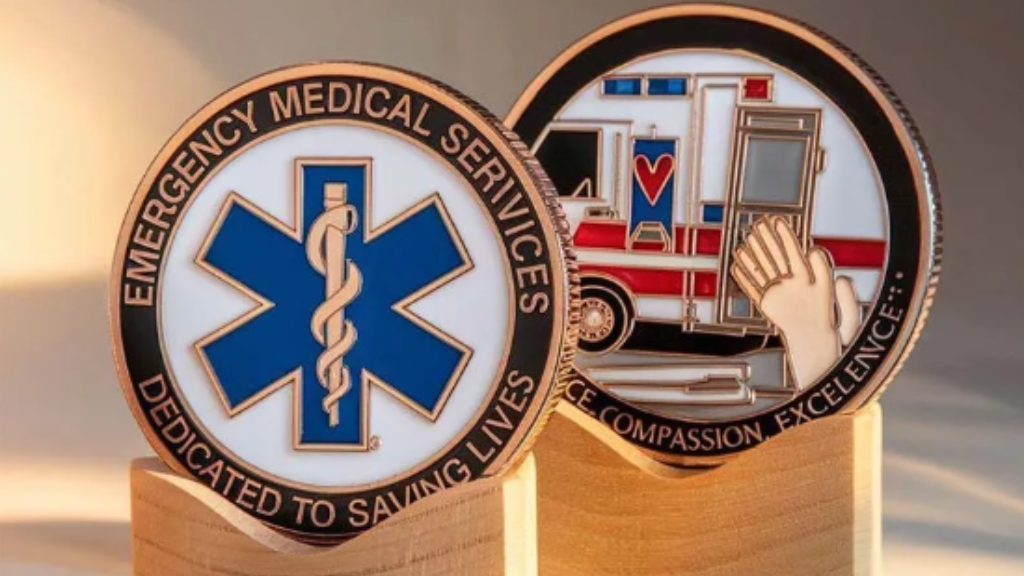
Star of Life | Six-pointed EMS star covering detection to transfer of care | ER, ambulance, trauma teams |
Red Cross / Red Crescent | International relief and emergency care | Disaster response teams |
Tree of Life | Growth, resilience, the cycle of care | Memorial and spiritual coins |
Guardian Angel | Protection, comfort at the bedside | Nurse appreciation gifts |
Heart with Pulse Line | The core of nursing: heart and monitoring | General nursing unit coins |
Crossed Stethoscope & Penlight | The everyday tools of the bedside nurse | Floor nursing coins |
Color choices are equally deliberate. Nursing blue and surgical green signal the clinical world; gold conveys honor; antique finishes suit daily pocket carry. Glow-in-the-dark enamel is a favorite for night-shift units — a coin that glows softly in a dark break room carries a quiet poetry day-shift staff can’t replicate.
When Coins Are Presented: Occasions and Protocols
Healthcare coins aren’t handed out randomly. Each presentation carries meaning, and the moment matters as much as the metal.
Occasion | Typical Recipient | Who Presents | Design Focus |
Nursing graduation / pinning | Newly graduated nurses | Faculty or preceptor | School seal, lamp symbol, class year |
New-hire welcome | First-job and travel nurses | Nurse manager | Facility logo, department, start date |
Resident Match Day (July) | New interns and residents | Program director | Hospital seal, year, specialty |
National Nurses Week (May 6–12) | All nursing staff | Hospital leadership | Facility logo, “The Power of Nurses” |
Specialty certification | Newly certified nurses (CCRN, CEN) | Clinical educator | Certification initials, year |
Promotion | New charge nurses / managers | Director of nursing | New title, facility seal |
Major incident response | Teams who handled a crisis | Incident leadership | Incident date, event name |
Travel nurse contract end | Completing travel nurses | Unit staff | Facility, dates, “mission complete” |
Peer kindness recognition | Any team member | Peer-to-peer | Kindness theme, pass-it-on design |
Retirement | Retiring nurses | Hospital leadership | Career span, years of service |
Memorial | Family and colleagues of a fallen caregiver | Hospital or unit | Name, dates, Tree of Life or lamp |
Protocol matters. A coin presented with a handshake and a short story — why this person, why this moment — is carried for years; coins handed out in a stack are trinkets. The narrative is the real metal.
Design Trends in 2026
The challenge coin market keeps growing. The global promotional products market is projected to reach 22.44 billion in 2026** (Business Research Insights), with challenge coins representing an estimated **380–420 million segment and corporate adoption rising roughly 34% (PPAI surveys). Healthcare is one of the fastest-growing verticals, shaped by several trends:
3D deep relief sculpting. Deep-mold sculpting brings a raised Nightingale lamp, a sculpted serpent, hearts that rise from the surface — a premium feel recipients notice immediately.
Glow-in-the-dark enamel. Luminous enamel glows softly in dark environments — perfect for night shifts. It turns a memento into something functional and quietly magical.
Dual-metal finishes. Bright gold with matte silver, antique bronze with black nickel — layered plating highlights key elements and gives healthcare coins the prestige of military and corporate pieces.
Serialized editions. Limited runs with individual numbers carry implicit scarcity; paired with a QR code linking to a digital certificate or memorial page, the coin becomes both keepsake and digital archive.
Custom shapes. Round coins remain standard, but health systems increasingly choose silhouettes — hearts for cardiac units, lamp shapes for pinning ceremonies, shield profiles for leadership awards.
Sustainable materials. RoHS-compliant plating and lead-free enamel are now requested in roughly 38% of quotes destined for the EU, and U.S. health systems are following. Recycled metal lets hospitals align recognition with sustainability commitments.
The Kindness Coin Effect
The most instructive healthcare coin programs aren’t grand ceremony coins — they’re designed to keep moving. Cooper University Health Care’s Kindness Coin program, now in its fifth year, works like this: any team member can request a bag of coins and hand them to colleagues observed doing small acts of compassion. Coins have holes so they clip behind badges, and recipients can keep the coin or pass it along to someone else caught doing good — deliberately designed to circulate, spreading recognition through the culture instead of collecting dust on a shelf.
The genius is that it makes recognition frequent, specific, and peer-driven — exactly what nurse surveys say matters most — and it costs almost nothing per coin.
The Numbers Behind the Caregiver's Coin
Metric | Figure | Source |
U.S. registered nurses | ~4.3 million | U.S. BLS, 2026 |
Total U.S. nursing workforce (RN + LPN + CNA) | 8 million+ | Industry estimates |
Gallup: nurses as most trusted profession | 23 consecutive years | Gallup |
Projected RN shortage by 2026 | ~264,000 | National workforce projections |
National RN turnover rate | 17.6% | NSI Report, 2026 |
National RN vacancy rate | 8.6% | NSI, 2026 |
Newly hired RNs leaving within first year | 22.7% | NSI, 2026 |
Average cost of turnover per bedside RN | $60,090 | NSI, 2026 |
Average annual hospital loss from RN turnover | 4.2M–6.2M | NSI, 2026 |
Nurses citing burnout as reason for leaving | 31.5% | Survey of 50,000+ RNs |
National Nurses Week 2026 theme | “The Power of Nurses” | American Nurses Association |
Global promotional products market (2026) | $22.44 billion | Business Research Insights |
Challenge coin segment | $380–420 million | Industry analysis, 2026 |
4.3 million RNs carry more than half of the U.S. healthcare workforce’s clinical load, in jobs where turnover costs more than $60,000 per departure. The organizations that hold onto them best make recognition a daily practice, not an annual event.
How to Order Healthcare Challenge Coins
- Define the purpose.Welcome coin, pinning coin, Nurses Week coin, peer-kindness coin, retirement, or memorial? Purpose drives shape, symbols, text, finish, and quantity.
- Choose your symbols.A nursing school coin without the lamp feels incomplete; an EMS coin without the Star of Life lacks context. Add unit numbers, specialty colors, or unit mottos.
- Select materials.Zinc alloy with gold or silver plating is the industry standard; premium solid brass at 3.5–4mm provides the heft for milestone awards.
- Consider 2026 add-ons.Glow-in-the-dark enamel for night shifts. QR codes linking to certificates or memorial pages. Serialized numbering for limited editions. Custom shapes for instant identity. Lead-free, recycled materials for green procurement standards.
- Order the right quantity.Minimums are typically 50–100 pieces, with pricing dropping significantly at 300+. For peer-recognition programs like Kindness Coins, budget for ongoing circulation, not just initial distribution.
- Plan the presentation.A coin handed over with a story — across a break room table, at a pinning ceremony, after a hard shift — carries weight a mass handout never will. The narrative is the actual value; the coin is just its physical form.
The Coin That Stays
In a profession where recognition is scarce and the emotional load is invisible to the outside world, the challenge coin is something tangible that says: we saw you.
It doesn’t fade or get lost in an inbox. It sits in a scrub pocket through twelve-hour shifts, gets pulled out years later by a retired nurse showing their grandkids what they did, and ends up in a shadow box that catches the light every morning.
That’s why nurses value them — not because they’re expensive, but because they represent what can’t be bought: the trust between people who carry life-or-death responsibility together, and the permanent marking of a career spent in service.
In 2026, as the market grows, the core tradition stays the same. A coin is struck. A story is told. A hand reaches out. And in a hospital somewhere in America — probably at 3 a.m., on a floor that’s short-staffed — a piece of metal becomes a memory a caregiver will carry for life.
That’s not a trend. That’s a tradition. And in healthcare, tradition is the quietest form of care.