
Table of Contents
Semper Fi at 251: The USMC Birthday Coin Tradition Explained for New Buyers
Every year on November 10th, something remarkable happens. In banquet halls in San Diego and Okinawa, at forward operating bases where the celebration is a cake ration under fluorescent lights, at Marine Corps League detachments in small towns across America — Marines pause. They put on dress blues or their best civilian suit. They stand a little straighter. And they say the same two words to each other, millions of times over the course of a single day:
“Happy Birthday, Marine.”
In 2026, the United States Marine Corps turns 251 years old. And if you’re reading this guide, there’s a good chance someone in your life wears the Eagle, Globe, and Anchor — or you belong to a detachment, a business, or a family that wants to mark the occasion with something permanent. Something like a challenge coin.
This article explains where the Marine Corps birthday tradition comes from, how challenge coins fit into it, what a good USMC birthday coin actually looks like, and — most importantly for first-time buyers — how to order one without stumbling into the etiquette traps, trademark issues, and timeline mistakes that catch newcomers every year.
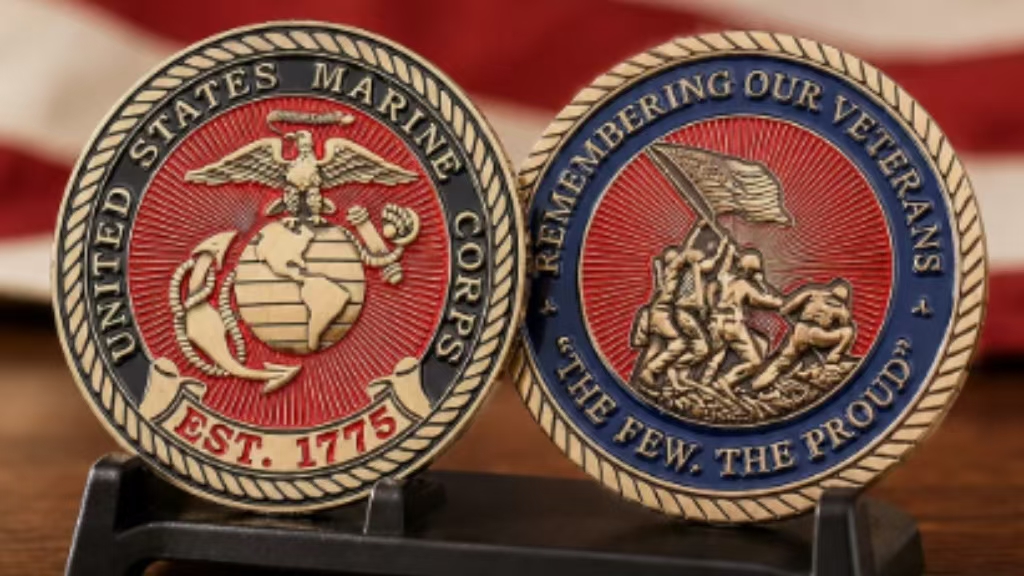
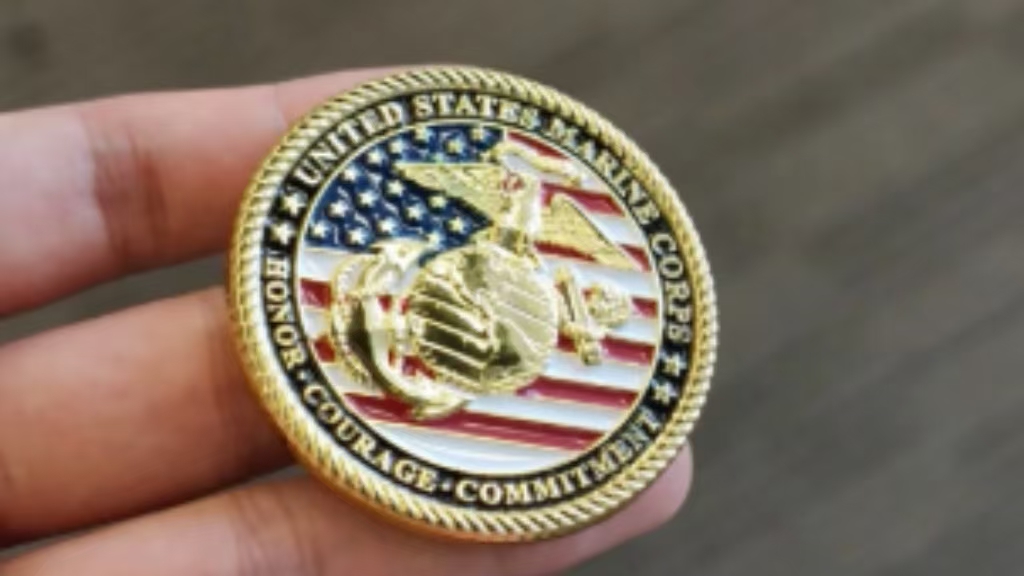
A Tavern in Philadelphia: 251 Years of History in Ninety Seconds
On November 10, 1775, the Second Continental Congress resolved that “two Battalions of Marines be raised” to serve as landing forces with the fleet. Tradition holds that the first recruits signed up at Tun Tavern in Philadelphia — which means the most feared fighting force in American history was, depending on how you look at it, founded in a bar.
The birthday itself wasn’t formally celebrated until 1921, when Major General John A. Lejeune — the 13th Commandant — issued Marine Corps Order No. 47, directing that the Corps’ history and traditions be read to every command each November 10th. That message is still read aloud at every Marine Corps birthday ceremony in the world, followed by a message from the sitting Commandant.
The centerpiece of the modern celebration is the cake-cutting ceremony, formalized in the Marine Corps Drill Manual in 1956. The first slice of cake goes to the guest of honor or the oldest Marine present. The oldest Marine then passes a slice to the youngest Marine present — a physical transfer of experience, from the Corps’ past to its future. It is, in its way, a challenge coin exchange rendered in cake: something passed hand to hand, from the one who earned their place first to the one who carries it forward.
And in 2026, the occasion carries extra weight. With America itself having just marked its 250th anniversary in July, Marine Corps community events this fall are embracing the theme “250 Years of America ~ 251 Years of Marines” — a reminder that the Corps is older than the country it defends by nearly a year.
Why Marines and Challenge Coins Are Inseparable
If any branch of the military owns the challenge coin tradition, it’s the Marine Corps. The coin check — the slammed-on-the-bar challenge that forces everyone present to produce their coin or buy the round — is practiced with particular enthusiasm in Marine circles. Unit coins, deployment coins, recruiter coins, and the informal handshake exchange between Marines who have never met but share the same title are woven into daily Corps culture.
The Marine Corps birthday amplifies this. Around November 10th every year, coins change hands at a rate that has no parallel on the military calendar:
- Detachments and unitspresent birthday coins at balls and ceremonies, often with the year and anniversary number struck into the metal.
- Marines exchange coinswith old friends from boot camp, prior units, and combat deployments — a birthday reunion isn’t complete without it.
- Family membersgive coins to sons, daughters, spouses, and grandparents who served, as a way of saying “I know what this date means to you.”
- Businesses and community organizationsproduce coins for veteran appreciation events, since the birthday (November 10th) and Veterans Day (November 11th) fall back-to-back, making mid-November one long window of veteran-focused activity.
The 250th anniversary in 2025 triggered a buying surge that industry observers compared to the Semiquincentennial effect on the broader commemorative coin market. The 251st won’t match that peak — but that’s precisely the opportunity. While 250th inventory is picked over and 2026’s “Semper Fi at 251” pieces are still being minted, early buyers get the pick of production slots ahead of the November crush.
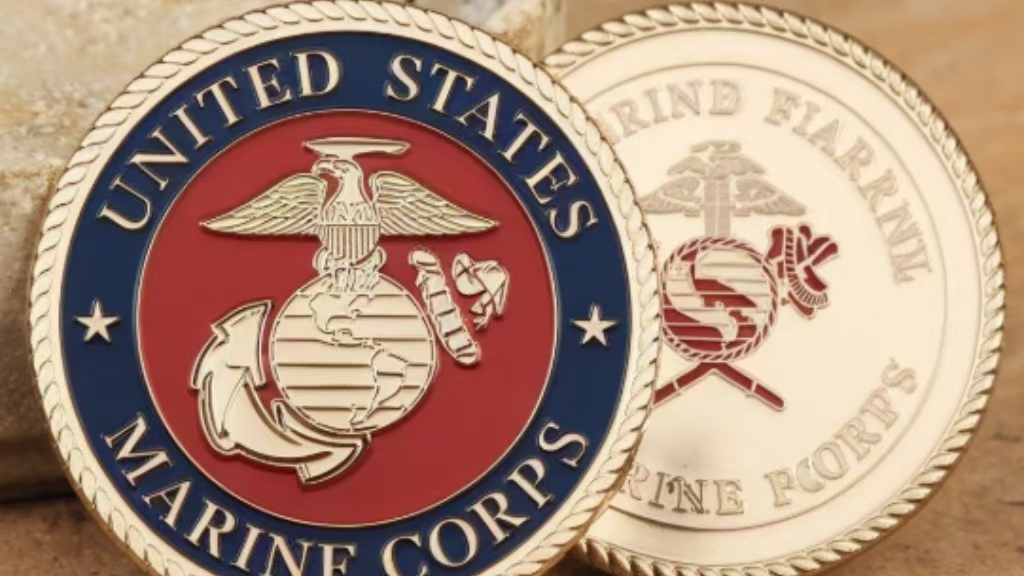
Reading the Language of a Marine Corps Coin
A well-designed USMC birthday coin speaks a visual dialect that Marines read instantly. Before you approve a design, make sure you understand what you’re saying.
Element | Meaning | Buyer Notes |
Eagle, Globe, and Anchor (EGA) | The official emblem of the USMC since 1868 | Trademark-protected — see the etiquette section below |
Bulldog (“Teufel Hunden” / Devil Dog) | German-reported nickname for Marines at Belleau Wood, 1918 | Widely used, strong recognition, trademark-safe alternatives exist |
Tun Tavern | The symbolic birthplace of the Corps | Excellent for anniversary coins; pairs well with “Since 1775” |
Scarlet & Gold | Official Marine Corps colors | Scarlet enamel against gold plating is the classic birthday coin look |
Oldest-to-Youngest / cake motif | The birthday cake-cutting ceremony | Unique to birthday coins; instantly understood by any Marine |
“Semper Fidelis” / “Semper Fi” | “Always Faithful” — the Corps motto | The most recognized two words in the Marine lexicon |
“1775–2026” or “251 Years” | The anniversary itself | Consider edge-text or serial numbering for limited editions |
Battle colors / streamers | Campaign history and unit lineage | Best for unit-specific or detachment coins |
The strongest birthday coins combine two or three of these elements — not all of them. A coin with an EGA, “Semper Fi,” and “251 Years of Marines” on a scarlet-and-gold field tells a complete story. A coin with eight competing symbols tells none.
Who Buys a 251st Birthday Coin? Probably You
First-time buyers tend to fall into four groups, and each group should design differently:
The family member. You’re buying for a Marine — a son back from his first deployment, a father who served in Vietnam, a spouse currently stationed overseas. Your coin should feel personal: consider adding a name, rank, or years of service on the reverse. Presentation matters more than quantity; a single coin in a velvet gift box lands harder than a handful of loose ones.
The detachment or reunion committee. Marine Corps League detachments, reunion groups, and unit associations order birthday coins in bulk for annual balls and membership drives. For 2026, serialized editions (“No. 47 of 250,” for example) add collectible value, and ordering 100–300 pieces keeps unit pricing reasonable.
The business or organization. If your company hosts a Veterans Day event, employs veterans, or supports a local Marine unit, a 251st birthday coin is a more dignified gesture than a branded water bottle. Keep your logo subtle — this coin honors them, not you. A tasteful approach: your organization’s name on the edge or reverse, with the Marine iconography carrying the front.
The collector. Anniversary coins hold value when they’re limited, well-made, and thematically coherent. Skip the kitchen-sink designs and look for 3D sculpted relief, dual plating, and documented edition sizes.
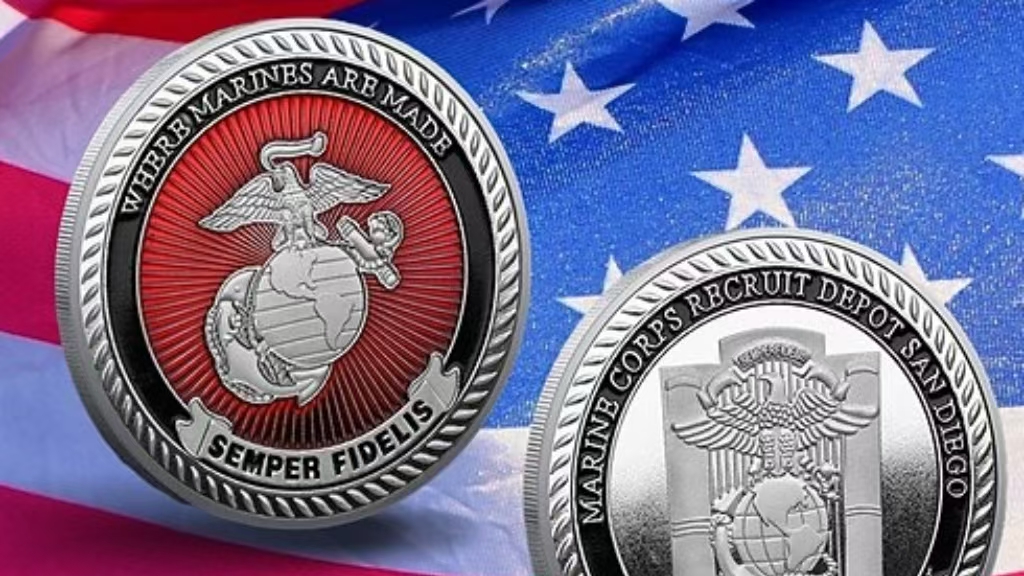
What 2026's Best Birthday Coins Look Like
The challenge coin market has matured dramatically, and anniversary coins are where premium craftsmanship shows up first. Current design standards worth knowing about:
3D deep relief. Flat 2D coins increasingly read as cheap. A sculpted EGA rising off the coin face, or a dimensional cake ceremony scene on the reverse, signals quality the moment it touches a palm. Marines, who judge everything by build quality, notice immediately.
Dual-plating finishes. Bright gold centers with matte silver rims, or antique bronze with black nickel, create contrast that makes key elements pop. For scarlet-and-gold birthday designs, dual plating is almost mandatory in 2026.
Serialized and numbered editions. An individually numbered coin — especially one limited to 251 pieces, playing on the anniversary — carries inherent scarcity. Some manufacturers pair serial numbers with QR codes linking to a digital certificate of authenticity.
Edge text. “10 NOV 1775 • 10 NOV 2026” running around the coin’s edge is an elegant way to add the anniversary without crowding the faces. Rope edges remain the classic choice; diamond-cut edges catch light under ballroom chandeliers, which matters more than you’d think for a coin whose first public appearance is at a formal dinner.
Presentation packaging. For birthday gifting, a velvet box or collector’s card sleeve with the story of Tun Tavern printed inside elevates a $12 coin into an heirloom-quality gift. Manufacturers report that packaging upgrades can increase perceived value by 40% or more.
The Timeline: Order Earlier Than You Think You Need To
This is where first-time buyers get burned every single year. Production takes longer than expected, proofing goes back and forth, and shipping in late October is at the mercy of peak-season logistics. Work backward from the ball:
Milestone | Target Date | Why |
Finalize design & artwork approval | Early–mid September | Allow two proof rounds; EGA-related designs need extra scrutiny |
Place order & pay mold fee | By September 30 | Secures a production slot before the holiday rush |
Production window | 3–5 weeks | Standard coins 2–4 weeks; 3D sculpting and serialized editions run longer |
Shipping buffer | 1–2 weeks | Late October shipping is congested with Veterans Day and holiday freight |
Coins in hand | By October 30 | Ball season runs roughly November 7–14; give yourself margin |
Presentation | November 10 | The birthday itself — or your local detachment’s ball date |
If you’re reading this in November already, ask your manufacturer about rush options — but expect to pay for them, and don’t skip the proof approval to save a day. A misspelled “Semper Fidelis” on 200 coins is a mistake you cannot unmake.
Etiquette and Legalities: The Three Rules New Buyers Break
Rule 1: Don’t imply you’re official. Your coin should never be confused with an official U.S. Marine Corps issue. Avoid replicating official seals so precisely that a reasonable person would think the USMC produced it. The best custom coins are clearly tributes — produced “in honor of” the Corps, not “by” it.
Rule 2: Understand the EGA trademark. The Eagle, Globe, and Anchor is a registered trademark of the U.S. Marine Corps, and commercial use requires licensing through the Marine Corps Trademark Licensing Office. Reputable manufacturers handle this — but “reputable” is the operative word. If a factory quotes you a suspiciously low price for a coin covered in official insignia with no licensing discussion at all, that’s your red flag. Alternatives like the bulldog, Tun Tavern imagery, scarlet-and-gold color schemes, and the words “Semper Fi” (used respectfully, not as a fake official mark) keep most tribute coins comfortably in the clear — and a licensed supplier solves the rest.
Rule 3: Present it properly. A birthday coin is given, not sold to the honoree; given with a handshake and ideally a few words about why. If you’re presenting to a group at a ball, coordinate with the ceremony organizer so the moment lands during the program, not over dessert. And if a Marine hands you a coin first — you’ve just been welcomed into something. Say thank you, and don’t hand it back.
What It Costs: A Realistic Budget Table
Quantity | Typical Unit Price (standard design) | Typical Unit Price (premium: 3D, dual-plated, serialized) | Best For |
1–10 | 12–25 each (or small-order minimums) | 20–40 each | Individual gifts |
50–99 | 5–9 each | 9–15 each | Small detachments, families |
100–299 | 3.50–7 each | 7–12 each | Reunion committees, unit coins |
300–500 | 2.75–5.50 each | 5–10 each | Detachment balls, organizational gifts |
500+ | 2.25–4.50 each | 4.50–8.50 each | Large events, retail-ready collectibles |
Expect a one-time mold/setup fee of 50–150 (more for complex 3D sculpting), and remember that the “251 of 251”-style limited editions justify their price through scarcity — don’t order 1,000 of them and call it limited.
251 Years, One Pocket
There’s a reason the Marine Corps birthday matters so much to the people who have earned the title. In a force of roughly 177,000 active-duty Marines plus reserves, only about 0.8% of living Americans have ever served in the Corps. The title “Marine” is earned once and held forever, and November 10th is the one day each year the whole tribe — active, reserve, retired, and the families who waited through deployments — marks it together.
A birthday challenge coin is the most fitting object in that ritual because it does what the day itself does: it compresses 251 years of history into something you can hold. It gets carried in a pocket through the next year, shown to grandchildren, traded at reunions, and eventually, decades from now, it will be the thing an old Marine digs out of a drawer on a November morning to show someone who asks what it was like.
That’s what you’re buying. Not a disc of zinc alloy with enamel. A place in a tradition that started in a Philadelphia tavern before the United States existed.
Order by the end of September. Present it with both hands. And if the recipient is a Marine — happy birthday to them, too.