
Table of Contents
Ride, Roar, Remember: How Motorcycle Clubs Are Adopting the Challenge Coin Culture
Pull into any motorcycle club cookout, charity run sign-up, or clubhouse gathering across America and you’ll hear it — the low clink of metal hitting a table, followed by a chorus of groans and laughter. Someone just got called out on a coin check. The rider who forgot their coin is buying the next round.
Challenge coins have been part of military culture for over a century and first responder culture for decades. Now they’re becoming part of motorcycle club culture — and not just as a novelty. For a growing number of riding clubs, MCs, and veteran motorcycle associations, challenge coins have become a serious tradition: a tangible marker of membership, a commemoration of miles ridden, a token of brotherhood traded between clubs at rallies from Sturgis to Daytona.
This article breaks down how challenge coins migrated from military squadrons to motorcycle clubs, why they resonate so deeply with biker culture, how major organizations like the Harley Owners Group are institutionalizing them, and what design trends are shaping motorcycle club coins in 2026.
From Formation Rides to Coin Checks: The Cultural Crossover
The pipeline from military culture to motorcycle culture is wider than most people realize. An estimated 30–40% of motorcycle club members in the United States are military veterans, according to surveys conducted by motorcycle advocacy organizations. Veteran motorcycle clubs — organizations like the Combat Veterans Motorcycle Association (CVMA), the Blue Knights, and the Iron Order Motorcycle Club — have membership requirements that include military or first responder service. These riders brought the challenge coin tradition with them when they traded barracks for clubhouses.
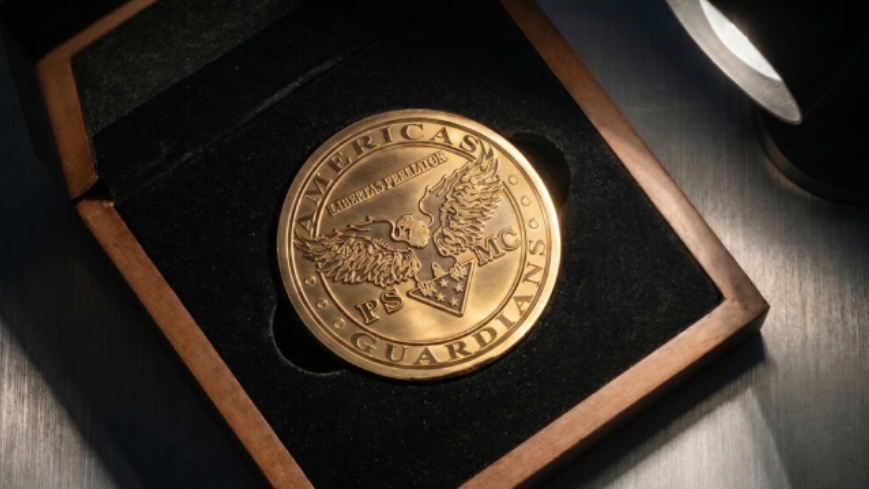
The crossover was organic. Military units had been striking coins since World War I to mark deployments and build unit cohesion. When veterans formed motorcycle clubs, they applied the same logic: a coin that says you were part of this, that you rode with these people, that you showed up when it mattered. The tradition then spread beyond veteran clubs to general riding clubs, brand-specific groups, and charity ride organizations. According to industry data, motorcycle club challenge coin orders have grown steadily over the past five years, with 2026 marking a notable acceleration driven by the Harley Owners Group’s institutional use of challenge coins in its riding challenges.
Why Motorcycle Clubs and Challenge Coins Fit Together
The appeal isn’t accidental. The two traditions share fundamental characteristics that make the crossover feel natural.
Brotherhood made tangible. The patch on the back of a vest represents years of prospecting, dues paid, and loyalty tested. A challenge coin serves as a pocket-sized extension of that patch — personal, carryable, intimate. While the vest patch is public, the coin lives in a jacket pocket or saddlebag, pulled out when the moment demands it.
The coin check as bonding ritual. The tradition of slapping a coin on a bar to challenge everyone present translates perfectly into motorcycle club culture. Bars, cookouts, and rally campsites are natural gathering places for riders, and the coin check turns those gatherings into interactive rituals. The penalty for being caught without your coin? Buying the next round. In a culture that already revolves around group rides and post-ride drinks, it fits seamlessly.
Milestones and miles. Motorcycle clubs measure commitment in miles. The H.O.G. Ride 365 program tracks annual and lifetime mileage, and the 2026 Let’s Ride Challenge ties challenge coins directly to mileage milestones. Riders who log 1,000 miles receive an exclusive challenge coin. This gamification — turning miles into tangible rewards — has normalized the idea that a challenge coin is something you earn through riding, not something you simply buy.
Inter-club diplomacy. When clubs meet at rallies or joint rides, exchanging coins serves as a gesture of respect and peaceful relations. A club coin bearing the organization’s full colors and location is a formal introduction — a calling card that says this is who we are, and we ride with respect.
The Harley Owners Group: Institutionalizing the Tradition
No organization has done more to mainstream challenge coins in motorcycle culture than the Harley Owners Group (H.O.G.). With over 1 million members worldwide and chapters in more than 100 countries, H.O.G. is the largest factory-sponsored motorcycle riding organization in the world. And in 2026, challenge coins are woven deeply into its programming.
The 2026 Let’s Ride Challenge
The Let’s Ride Challenge Ride for Heroes runs from March 28 to October 31, 2026, inviting all Harley-Davidson riders to log miles in support of a $1 million donation to charities serving military, veterans, and first responders. The milestone rewards:
Milestone | Reward |
First odometer reading | Let’s Ride Challenge Sticker |
500 miles | Let’s Ride Challenge Keychain |
1,000 miles | Let’s Ride Challenge Coin |
2,500 miles | Let’s Ride Challenge Flashlight |
5,000 miles | H.O.G. collectible hat + 2,500 bonus points |
10,000 miles | Let’s Ride Challenge Water Bottle |
The coin sits at the 1,000-mile mark — far enough to require real commitment, early enough to be achievable for most active riders. It’s the first premium reward, the one that transitions the challenge from participation to achievement.
15 for ’26 and 50 Rides, One Nation
H.O.G.’s 15 for ’26 Challenge selects 15 iconic American riding destinations each year — from the O.K. Corral in Tombstone, Arizona to Cadillac Ranch in Amarillo, Texas. Riders who visit a destination and submit a photo receive an exclusive challenge coin for each destination. A dedicated member can earn up to 15 distinct coins in a single year.
Even more ambitious is 50 Rides, One Nation — a lifetime challenge selecting one iconic riding route in each of the 50 U.S. states. Riders earn a commemorative coin for each state completed. Those who finish all 50 receive their name engraved on a rivet at the Harley-Davidson Museum in Milwaukee. This is challenge coin culture at its most powerful: a multi-year pursuit that transforms riding into a documented legacy, with each coin serving as a physical checkpoint in a rider’s personal history.
The Language of Motorcycle Club Coins
Like fire and EMS coins, motorcycle club challenge coins speak a visual language that insiders read instantly. Every element carries meaning:
Symbol | Meaning | Common Use |
Club colors / patch | Full organizational identity | Primary membership coins |
Eagle or wings | Freedom, American heritage | Patriotic-themed club coins |
Crossed motorcycles | Brotherhood, riding partnership | Dual-chapter or friendship coins |
Skull or skeleton | Rebellious heritage, 1% tradition | Outlaw club aesthetic, memorial coins |
Road / highway imagery | The journey, miles ridden | Mileage milestone coins |
State outline | Chapter location, regional identity | Chapter-specific coins |
Thin Line (Blue/Red/Green) | Support for LE, fire, military | Veteran and first responder MC coins |
Winged wheel | Motorcycling heritage | Brand-specific or heritage coins |
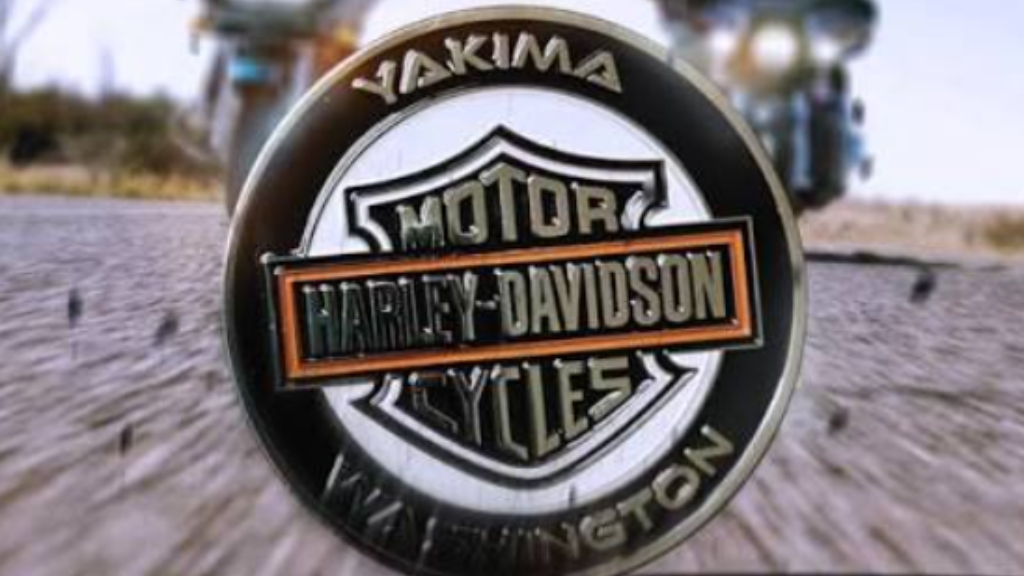
Color choices tend to be bolder than in corporate or military coins. Black and chrome silver dominate, reflecting biker aesthetics. Orange is prominent in Harley-Davidson-affiliated coins. Antique bronze and distressed finishes convey the rugged, road-worn character that resonates with riding culture.
Design Trends in 2026
The global promotional products market is projected to reach 22.44 billion in 2026**, with challenge coins representing an estimated **380–420 million segment. Motorcycle club orders are a growing slice, driven by both individual club commissions and institutional programs like H.O.G.’s riding challenges.
Custom shapes. Motorcycle clubs increasingly opt for shield silhouettes, motorcycle profiles, wing shapes, and state outlines — a coin shaped like a Harley fuel tank or Route 66 sign communicates its origin instantly.
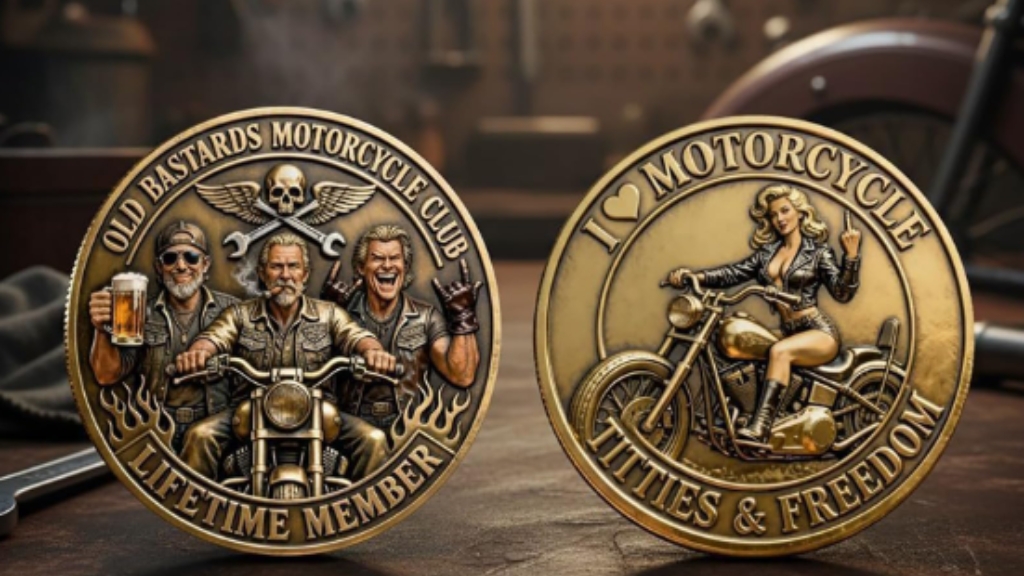
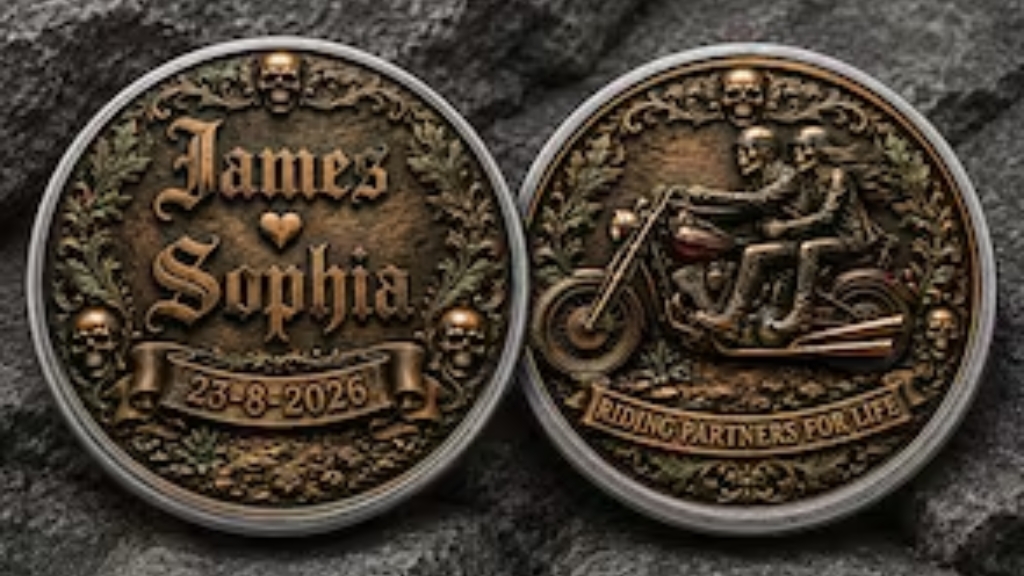
3D deep relief sculpting. Flat 2D designs are giving way to sculpted eagles that rise from the surface, motorcycle engine replicas with visible cylinder fins, and skull designs with contoured depth. The tactile quality resonates with a culture that values mechanical craftsmanship.
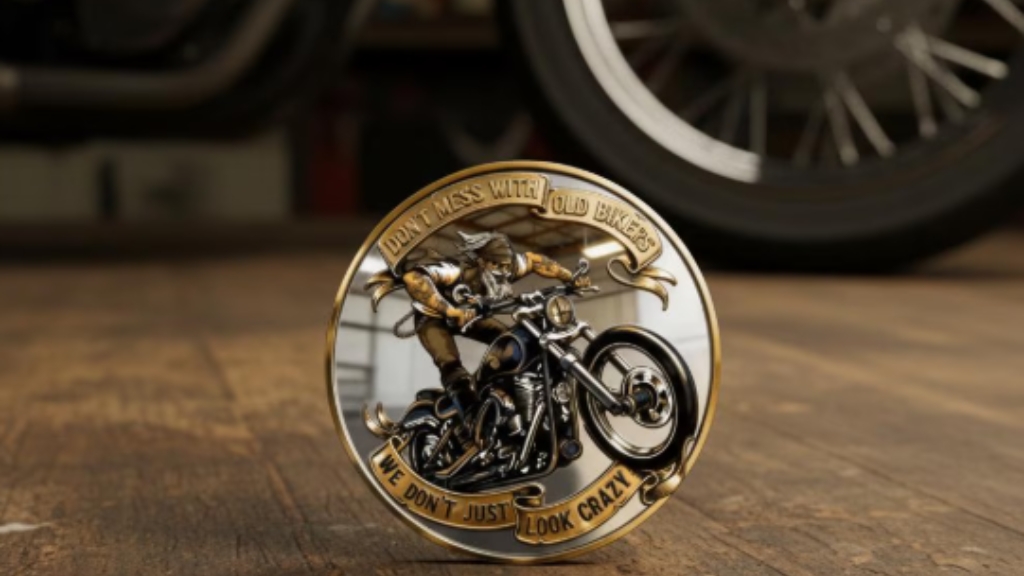
Dual-metal and distressed finishes. Black nickel combined with bright silver creates an aggressive aesthetic. Antique bronze with vintage distressing conveys a weathered, road-worn character. Dual-metal plating — gold accents on gunmetal, copper highlights on matte black — adds drama without increasing coin size.
Serialized editions and QR codes. Limited runs with individual serial numbers (“023 of 100”) elevate perceived value and create secondary collector markets. Laser-etched QR codes link to chapter websites, memorial pages for fallen riders, or digital registries that verify membership authenticity — a practical 2026 innovation.
The Numbers Behind the Tradition
Metric | Figure | Source |
U.S. motorcycle club fans | 16.7 million | Rascasse, 2026 |
Median age of MC audience | 38 | Rascasse, 2026 |
AMA members | 200,000+ | AMA |
AMA-authorized clubs in the U.S. | 1,100+ | Marshal Moto |
H.O.G. members worldwide | 1,000,000+ | Harley-Davidson |
Total U.S. motorcycle clubs | 3,000+ | Bikedemy |
Sturgis Rally attendance | Up to 500,000 | Event estimates |
Challenge coin market segment | $380–420 million | Industry analysis, 2026 |
Veteran MC members | 30–40% of MC membership | MC advocacy surveys |
Nearly 17 million Americans identify as motorcycle club enthusiasts. Over a million H.O.G. members worldwide are actively participating in riding challenges that award challenge coins. Thousands of independent clubs are commissioning their own coins. The market exists because the culture demands tangible markers of intangible bonds.
How to Order Motorcycle Club Challenge Coins
- Define the purpose.Membership coins, charity ride commemoratives, rally giveaways, mileage milestones, and memorials each demand different design decisions. Membership coins need full club colors and daily-carry durability. Memorial coins require solemn aesthetics and personal details.
- Respect the club’s identity.If your club has formal colors and a motto, those belong on the coin. For clubs within larger organizations like H.O.G., check design guidelines. For independent clubs, ensure the coin accurately represents the patch — incorrect colors can cause offense.
- Choose materials and finishes.Zinc alloy with black nickel and silver dual-plating is the most popular choice — durable, cost-effective, and matched to biker aesthetics. For premium coins, solid brass at 3.5–4mm thickness provides the heft riders expect. Consider 2026 add-ons: custom shapes, 3D relief, QR codes, and serialized numbering for limited editions.
- Order the right quantity and establish protocol.Most manufacturers have low minimums (50–100 pieces), but unit pricing drops significantly at 300+. Plan how coins will be presented — a membership coin at a patch-in ceremony carries different weight than one handed across a bar. A coin without a story is just metal. A coin with a story becomes a tradition.
The Road Ahead
Motorcycle culture has always been about more than the machines. It’s about the people who ride them, the roads they share, and the bonds they forge. Challenge coins capture all of that in a piece of metal that fits in the palm of your hand.
In 2026, the tradition is deeper and more widespread than ever. H.O.G. has institutionalized challenge coins as riding rewards. Independent clubs are commissioning increasingly sophisticated designs. Inter-club trading serves as a protocol for respect. And the coin check — that simple ritual of slapping metal on a bar — remains alive at every rally and clubhouse from coast to coast.
The motorcycle club challenge coin isn’t a trend. It’s a tradition being forged in real time — one mile, one member, one handshake at a time. The bikes will change. The roads will change. The riders will come and go. But the coins? Those stay. Carried in pockets, displayed on shelves, traded between strangers who become friends, and eventually passed down to the next generation of riders who will hear the story of where they came from.
Ride, roar, remember. The coin keeps the memory.