
Table of Contents
Mile 26.2, Metal in Hand: The Marathon Finisher Coin Movement
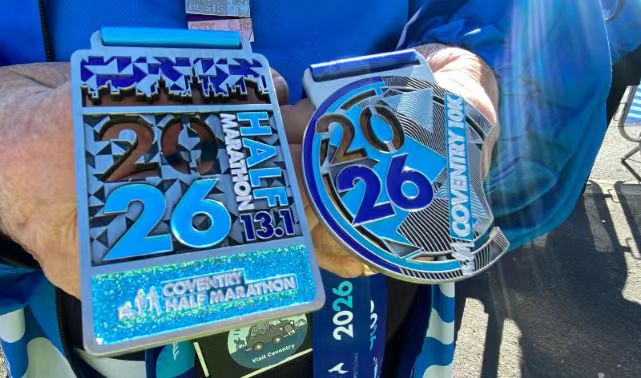
On the first Sunday of November, more than 50,000 runners will cross the finish line of the TCS New York City Marathon. Every one of them will receive the same thing: a large, glittering medal on a ribbon. But scroll through finisher accounts on Instagram that evening — or wander the expo the Friday before — and you’ll notice a second, smaller object appearing alongside the medal. A two-inch disc of solid metal. No ribbon. No box. Just weight.
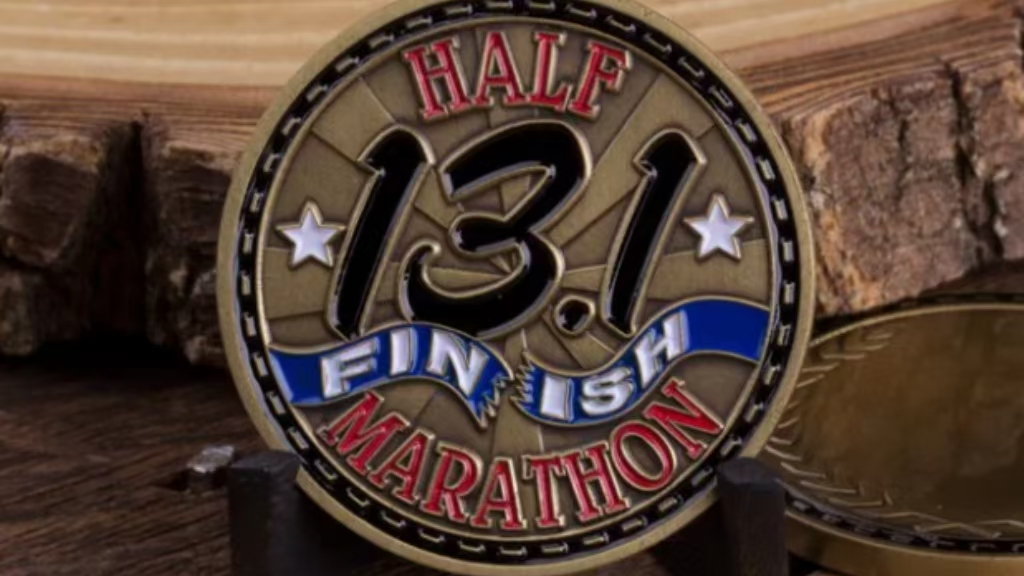
It’s a marathon finisher coin, and it’s quietly becoming one of the fastest-growing keepsakes in running. Even the Abbott World Marathon Majors — the governing body of the sport’s six most prestigious races — now sells an official “collectible journey range of coins and displays,” one coin per Major, built for runners to mark every step of the road from one star to the next.
When the most tradition-bound institution in road running starts minting coins, it’s worth asking why. The answer runs through a running boom, a medal glut, and a military tradition that turns out to be a perfect fit for people who just ran 26.2 miles.
The Running Boom Is Running Hot
Start with the demand side, because it has never been stronger.
The 2026 TCS London Marathon ballot received 1,133,813 applications — a world record, up roughly 35% from the 840,318 who applied for 2025. New York drew more than 240,000 entries into its drawing for 2026. The Boston Marathon, the only Major you can’t lottery into, accepted a field of 30,000 for 2026 with a cutoff time 4 minutes and 34 seconds faster than its already-brutal qualifying standard — 33,249 qualified applicants applied, and thousands were turned away. Chicago expects its largest field in history this fall, while Germany’s Cologne Marathon grew participation by 41% in a single year.
Translation: getting into a major marathon is now harder than getting concert tickets, and finishing one has become one of the last genuinely earned achievements in modern life. Nobody can buy it for you. No algorithm can fake it. When an achievement is that scarce and that personal, people look for a way to carry it — and the market has noticed: the global promotional products industry, which includes custom challenge coins, is projected to reach **22.44 billion in 2026**, growing to 46.21 billion by 2035.
Medal Fatigue: The Ribbon Problem
So why are runners adding coins when they already get medals? Because the medal itself has a problem — there are too many of them.
Race organizers spent the last decade competing on swag: every 5K now issues a full-size medal, virtual races mail medals to people who ran around their neighborhood, and theme-park half marathons hand out dinner-plate medals — plus “challenge” variants on top. Ask a ten-year veteran of the sport what happens to the pile, and you’ll hear the same phrase: the drawer. Every runner has one. The medals go in the drawer.
The economics of sentiment are unforgiving: when everyone gets the same object, the object stops feeling special. A finisher medal now proves you finished — it no longer feels like a treasure.
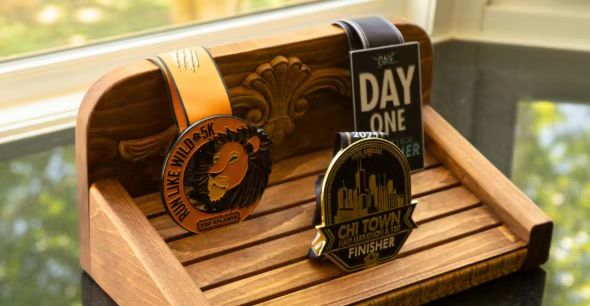
The finisher coin is the counter-trend. It’s small enough to live in a pocket, on a key ring, or on a desk instead of a drawer. It’s heavy and dense where medals are big and light. It’s designed to be flipped, carried, shown, and exchanged rather than hung on a wall and forgotten. And at a time when race photography has moved to flat-lays and macro shots, a coin photographs like jewelry — antique plating, deep 3D relief, and colored enamel read as craft, not as giveaway.
| Finisher Medal | Finisher Coin |
Format | 3–4″ wide, hung on a ribbon | 1.75–2″ disc, pocketable |
Where it ends up | Wall, medal hanger, or “the drawer” | Pocket, key ring, desk, display case |
Everyday visibility | Race-day only | Carried daily, flipped, shown |
Unit cost | Higher per piece | Lower per piece |
Shipping & logistics | Bulky, breakable ribbon attachments | Ships flat, lightweight |
Scarcity potential | Mass-issued to every finisher | Easily numbered (e.g., 041/250) |
Craft ceiling | Stamped zinc with ribbon | 3D deep relief, dual plating, glow enamel, NFC |
None of this means coins are replacing medals. It means they’re doing a different job: the medal marks the day, the coin marks the identity.
Earned, Not Bought: Why Runners Took to the Coin
The challenge coin tradition began in the U.S. military a century ago, and its core rule has never changed: a coin is earned, never bought. You receive it from someone who witnessed what you did. Carrying it is proof of belonging. And if a fellow coin-holder calls a “coin check,” you’d better produce it.
Compare that to the ethos of marathon running. A finisher’s medal can’t be purchased, gifted, or faked into existence — you cover every one of the 26.2 miles yourself, through the wall, through the weather, through the moment at mile 20 when everything in you asks to stop. There may be no civilian achievement more structurally identical to what challenge coins were invented to honor.
That’s why the tradition has spread through running culture organically, the same way it spread through firehouses and squad rooms:
- Training clubscommission season coins for members who survived a 16-week marathon block together.
- Pace groupsmint coins for the leaders who carried hundreds of strangers to a finish time.
- Running streak clubsand sub-4:00 “secret societies” issue coins that function exactly like unit coins — recognition from people who know exactly how hard it was.
- Coacheshand a coin instead of a card to athletes on the morning of the race — or, better, at the finish.
The Six Star Effect: When the Majors Went Official
If you want proof this movement has gone mainstream, look at what the Abbott World Marathon Majors did next.
In 2016, the Majors introduced the Six Star medal — awarded to runners who complete all six original races: Tokyo, Boston, London, Berlin, Chicago, and New York. It’s arguably the most coveted object in mass-participation sport. More than 23,000 runners worldwide have earned it, and demand is accelerating: over 5,000 claimed it in 2025 alone, with another 10,000-plus runners currently sitting on five stars, one race away.
Then the ground shifted. Sydney joined as the seventh Major in 2025. Cape Town was confirmed as the eighth in June 2026, and Shanghai is in the final stage of evaluation — which means a Nine Star medal is now officially on the roadmap. The journey that once had one finish line now has a second, and a third on the horizon.
Here’s the part that matters for this story: to let runners celebrate that multi-year journey, the Majors didn’t make bigger medals. They launched an official collectible coin range — one coin per Major — with displays built to hold two to eight coins as a runner collects stars. The most traditional institution in running chose the challenge coin as the format for its most ambitious commemorative program. That decision validates what race organizers at every level have been discovering: coins are the native collectible of the running boom.
The Race Director's Math
For race organizers, the finisher coin isn’t sentiment — it’s strategy. Five reasons the math works:
- Margin and logistics.A coin costs less per unit than a large die-struck medal, ships flat instead of in bulky packaging, and survives transport without ribbon attachments snapping off. For an event shipping 10,000 finisher items, that difference compounds fast.
- Sponsor inventory.A coin is a miniature billboard that people voluntarily carry. Sponsor logos can be integrated into the design — on the edge, in the reverse layout, or as a dual-plated accent — instead of printed on a ribbon nobody photographs.
- It travels.A medal hangs on a wall at home. A coin goes to the office, to the next race’s expo, to the group run — and every pocket it rides in is a conversation. “What’s that?” is the most cost-effective marketing a race can buy.
- The charity lever.The proof here is already on the board. The Hong Kong Marathon’s charity program awards an exclusive “Charity Champion” challenge coin — distinct from the standard finisher medal — to runners who raise above HKD $5,000 for official charity partners. The result: a documented 40% increase in average fundraising per participantamong coin-eligible runners. The coin gave fundraisers a visible, wearable tier of prestige above the medal, and the numbers followed.
- Scarcity on demand.Numbered editions (coin 041 of 250) create a reason to register early and a reason to come back next year for the next coin in a series — the exact mechanics that drive the Six Star economy, scaled to any local race.
Designing a Coin Worth 26.2 Miles
A marathon coin should tell the story of the specific race — the design language that separates a keepsake from a generic giveaway.
Design Element | Why It Works |
Route map on the reverse | The course is the race’s fingerprint; a miniaturized route line is instantly recognizable to anyone who ran it |
Elevation profile | Boston’s Newton hills or Sydney’s 313 metres of climbing, rendered in deep 3D relief — a badge of honor for those who survived it |
Custom engraving space | Leave a blank banner for finish times; a coin engraved “3:58:42” beats any generic “FINISHER” stamp |
Bib number cutout | An irregular cut-out in the runner’s race number makes each coin order personal at batch pricing |
Custom shape | Bridge silhouettes, state outlines, or a “26.2” numeral coin break from the round standard |
Glow-in-the-dark enamel | Built for predawn start lines and midnight training runs — and it photographs dramatically on social |
NFC / QR chip | Tap the coin to load the official results page or a finisher video — the physical medal with a digital heartbeat |
Antique or dual plating | Reads as premium and heirloom-quality rather than giveaway-grade |
Two production notes for organizers: deep 3D sculpting is the right choice for city skylines and elevation profiles — it’s the craft level that made deep-relief minting the breakout premium format at 2026 industry trade shows. And if your ordering window collapsed, express UV-printed coins now ship in as little as 1–3 days — a genuine race-week lifeline that didn’t exist two years ago.
The Runner's Side: A Second Collection Begins
For runners, the appeal is simpler. The medal proves you finished. The coin tells the story.
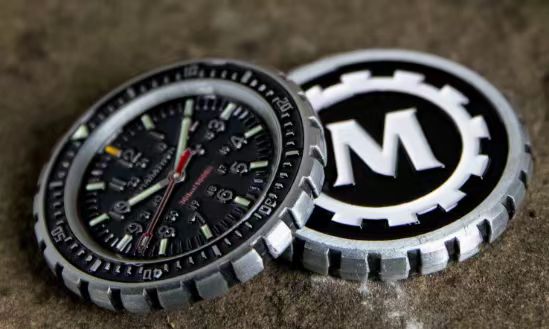
On TikTok, coin content behaves more like #coincheck ASMR than medal hanging — flips, macro detail shots, flat-lays next to bibs and pace bands. Coins get carried to expos, where runners have started trading duplicates like veterans at a reunion. And the gifting angle is real: training partners exchange coins engraved with inside jokes (“You talked me through Mile 20”), and spouses commission one for the person who endured every 6 a.m. long run alongside the runner.
A collection that starts with one coin tends not to stop. First the marathon coin, then the club coin, then the BQ coin, then the Six Star journey — the display case fills the way a race calendar does, one earned line at a time.
Launching a Finisher Coin Program: A Working Timeline
For race directors considering coin No. 1, here’s a realistic runway built around standard production schedules:
Countdown | Action |
12 weeks out | Set the concept and budget: finisher edition, charity tier, or club coin? Decide quantity (a limited numbered run of 10–20% of field size creates built-in urgency) |
10 weeks out | Request artwork — most custom coin suppliers provide free design proofs; allow two revision rounds |
8 weeks out | Approve the final design and place the order; confirm the mold fee is one-time (you’ll reuse it for next year’s dated variant) |
3 weeks out | Assess inventory and place an express UV top-up order if pre-race sign-ups surged; 1–3 day production plus air freight still lands in time |
Race week | Unveil at the expo; if the edition is numbered, display the full set — runners who see coins 001–050 already gone will remember that in 2027 |
The veterans of the industry will tell you the first coin a race mints is rarely the last. The year after a successful launch, organizers hear one question more than any other at packet pickup: “Are you doing the coin again?” That question is worth more than the coin that prompted it — it’s proof the race has graduated from an event people attend to a tradition people collect.
Twenty-six point two miles earns more than a ribbon. It earns something with weight to it.