
Table of Contents
Decades of Dedication: Why Service and Anniversary Pins Still Matter
The conference room is quiet. Thirty people are on their feet, and a woman in her late forties is walking to the front to receive her twenty-fifth-year pin from the CEO. On her lapel, a row of smaller pins tells a story no résumé can: one year, five, ten, fifteen, twenty. She turns the new pin over, reads her name and the year she started — 2001 — and for a moment, she’s back at her first desk.
This scene plays out in thousands of companies every year, and it’s easy to dismiss the service pin as a corporate relic. But the data says otherwise. In an era when the median American worker stays at a job for just 4.1 years, the service pin is quietly becoming one of the most powerful retention tools a company owns.
This article explores where the service pin tradition came from, why it survives — and thrives — in an age of short tenures, what the numbers say about its impact, and how organizations can build a pin program employees actually keep.
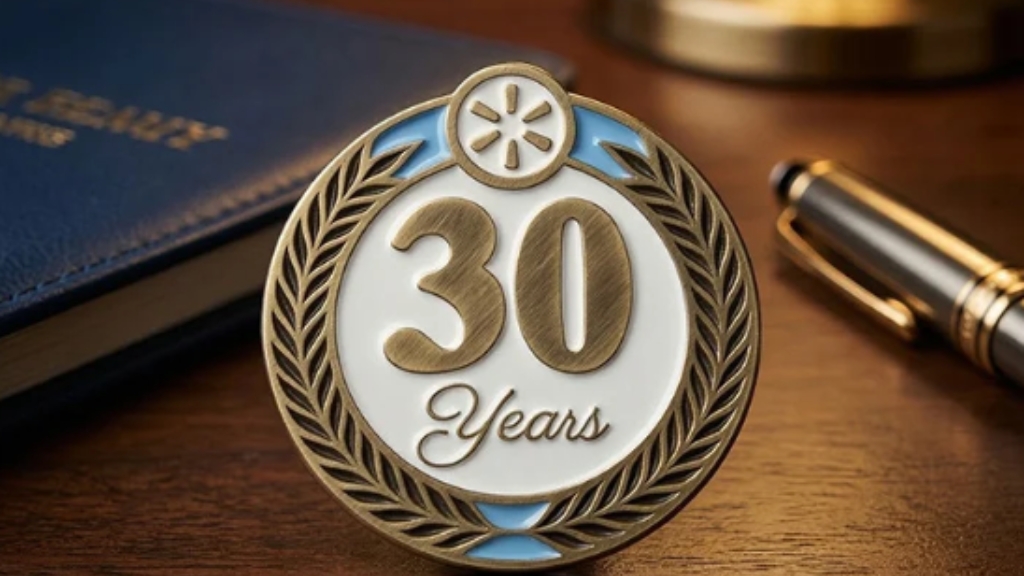
A Century-Old Tradition, Born in Metal
The service award is one of the oldest formal recognition practices in the working world. Its roots reach back to the early 1900s, when manufacturing companies began presenting gold watches to workers retiring after decades on the line. The watch was the first widely used symbol of a simple idea: staying matters.
By the 1930s and 1940s, the lapel pin had taken over as the emblem of the era. Companies struck small enamel pins marking five, ten, or twenty-five years of service — visible, wearable, and cheap enough to give to every worker on the floor. Historians of the recognition industry call this the “emblematic period,” and its influence never fully faded. The decades that followed layered new formats on top: certificates in the 1950s and 60s, heirloom watches and crystal in the 1970s and 80s, social recognition platforms in the 1990s and 2000s, and mobile-first tools from 2010 onward.
Through every shift, the pin kept its place. Governments, militaries, police, fire services, and airlines — institutions where longevity genuinely matters — never stopped striking service pins. The private sector drifted toward plaques and catalogs, but the pin tradition survived in the organizations that understood its core mechanic: a pin is the only recognition object designed to be worn, seen, and carried everywhere the employee goes.
That mechanic is why, in 2026, the pin is coming back to the corporate mainstream.
The Problem with Modern Tenure
Here’s the uncomfortable truth about service awards today: most employees never live long enough at one company to earn one.
The U.S. Bureau of Labor Statistics puts median tenure at 4.1 years — and for workers aged 25 to 34, the median drops to 2.8 years. Roughly 22% of workers aged 20 and older had been with their employer for one year or less in 2022. Meanwhile, only 27% of organizations reward employees at the one-to-three-year mark. The result is a mismatch: traditional service awards start at five years, but most of the workforce is gone before the first pin is ever struck.
The second problem is that even the awards people do receive often fail. One recognition provider’s client reported that half of their employees left traditional service awards sitting on their desks when they quit — plaques and paperweights no one wanted to carry out the door.
This is exactly where the pin wins. A pin is not a desk ornament. It’s worn on a lapel, a lanyard, a uniform, or a backpack — visible to the employee all day and to everyone around them. It costs a fraction of a plaque, but it does something a plaque can’t: it travels.
Service and anniversary pins still matter in 2026 because they solve the two failures of modern recognition:
- They start early.A one-year pin is affordable enough to give everyone, and it plants the flag of belonging before the 2.8-year danger zone. Programs that begin at year one give the majority of the workforce their first recognition moment instead of reserving it for the lucky 13% who reach a decade.
- They build timelines.One pin is a trinket; a row of pins is a career. When milestones are designed as a series — a different metal, finish, or gemstone at each level — the employee’s lapel becomes a visual career timeline that they themselves maintain. Leaving means breaking the set.
- They make recognition public.Recognition research consistently shows that public acknowledgment amplifies impact. A pin worn at work announces the achievement to peers every single day, not just during one meeting.
- They anchor stories.The pin itself is cheap. The moment it represents — the handshake, the speech, the surprised tears — is priceless. Years later, the pin is the physical key that unlocks the memory.
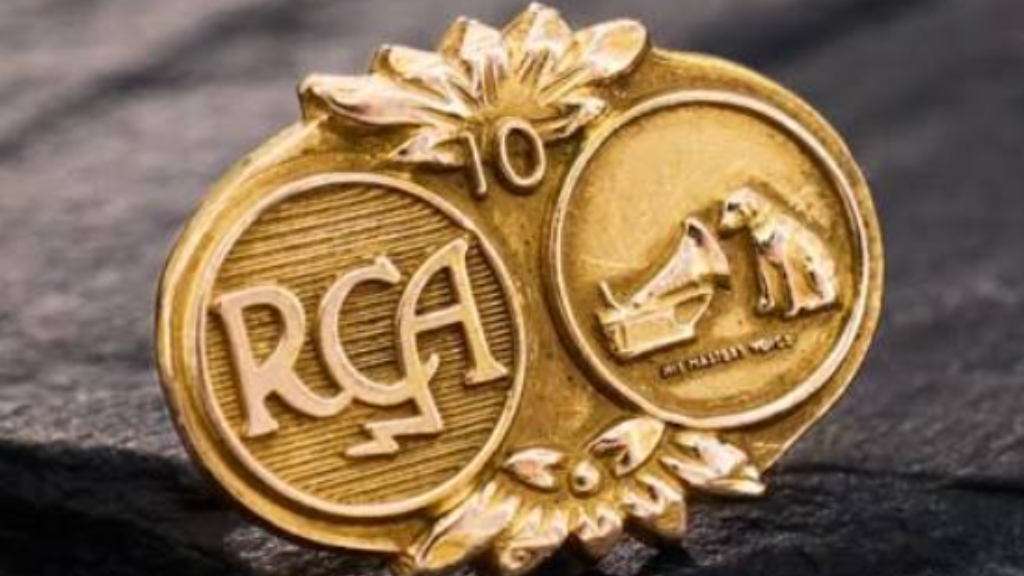
The Numbers Behind Decades of Dedication
The business case for service recognition is backed by some of the strongest data in HR research. Here’s what the numbers say:
Metric | Figure | Source |
Median U.S. job tenure | 4.1 years (2.8 for ages 25–34) | U.S. Bureau of Labor Statistics |
Organizations running a service award program | 87% | WorldatWork |
Organizations rewarding 1–3 years of service | Only 27% | BI WORLDWIDE |
Employees receiving high-quality recognition who left within 2 years | 45% less likely | Gallup & Workhuman, 2024 |
Annual turnover savings for a 10,000-employee company | Up to $16.1M | Gallup & Workhuman |
Voluntary turnover at companies with strong recognition culture | 31% lower | Deloitte / Bersin |
Extra tenure at companies with strong service award programs | 2–4 years longer | O.C. Tanner Institute |
Employees who receive meaningful service awards staying another 5 years | 2x more likely | O.C. Tanner |
Cost to replace an employee | 80–200% of annual salary | Gallup |
Employees who feel appreciated being engaged | 2x more likely | Gallup, 2024 |
Employees citing lack of recognition as reason to switch jobs | 43% | Industry survey |
The math is simple. Replacing one mid-career employee can cost 30,000 to 150,000 in recruiting, training, and lost institutional knowledge. A service pin program that measurably improves retention costs a few dollars per employee per year. It’s one of the highest-leverage investments an HR team can make — and one of the most underused.
Milestones by the Numbers
A well-designed service pin program follows a tiered structure, with design and ceremony escalating at each level. Most organizations use some version of this ladder:
Milestone | Typical Recognition | Reward Value | Pin Design Focus |
1 year | Welcome anniversary, manager acknowledgment | $25–50 | Company logo, small enamel pin, start year |
3 years | Certificate, first formal pin | $50–100 | Department or division emblem |
5 years | Formal award, milestone pin | $150–300 | Gold-tone finish, milestone numerals |
10 years | Major milestone, premium selection | $300–750 | Dual-metal finish, personalized engraving |
15 years | Elevated award, high-value selection | $500–1,500 | Custom shape, precious-metal plating |
20 years | Premium celebration | $1,000–2,500 | Gemstone accent, executive presentation |
25+ years | Top-tier award, legacy tribute | $1,500–3,000+ | Diamond or sapphire, name + years engraved |
The pattern matters as much as the metal: each level must look like a progression. When a 25-year pin is recognizably the crown of a series the employee has been collecting since year one, the entire program becomes a story — and the employee becomes its protagonist.
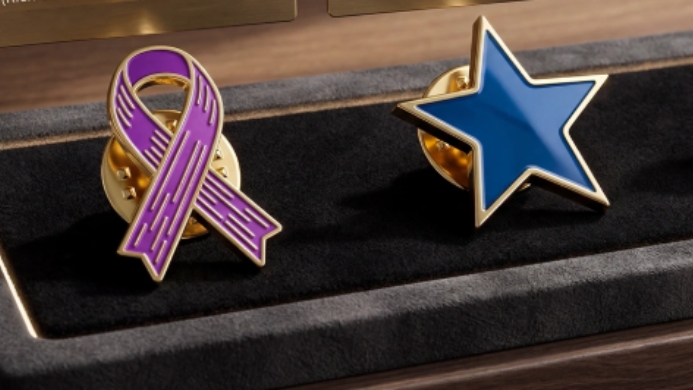
2026 Design Trends
The service pin market is evolving fast, and 2026’s trends all point one direction: pins people want to wear, not store.
Personalization is the new baseline. Names, start dates, department, and milestone years are table stakes now. The most-cited detail in 2026 programs is engraving on the reverse — a name and a year that make the pin undeniably theirs.
Material-layered milestones. A growing trend is escalating materials rather than just size: a jade-inlaid pin at five years, silver at ten, gold at fifteen, diamond-accented at twenty. The material itself tells the tenure story at a glance.
Premium craftsmanship. Matte and antique finishes, 3D embossed structure, and dual-metal plating have replaced glossy flat enamel in the most effective programs. A heavier, better-finished pin reads as more valuable — and gets worn more often.
Sustainable sourcing. Lead-free enamel, recycled metal, and RoHS-compliant plating are increasingly requested, letting recognition programs align with corporate ESG commitments.
Smart pins. QR codes and NFC chips on the reverse link the pin to a personalized video message, a digital credential, or a LinkedIn-shareable badge — bridging the physical keepsake and the digital workplace.
Collectible series design. Rather than a new isolated pin every milestone, programs are designing sets that fit together — a display board, a lanyard chain, a shadow-box layout — turning a career into a collection.
Case Study: Pins That Cut Turnover 18%
One of the best-documented examples comes from a luxury hospitality group in Hong Kong, which faced the industry-wide problem of high staff turnover. They had competitive salaries but no tradition of honoring tenure.
Their fix was a personalized years-of-service pin program: a jade-inlaid pin at 5 years, silver at 10, gold at 15, and a diamond-accented pin at 20+, each engraved on the reverse with the employee’s name and joining year. The pins were presented by the CEO at the annual gala, with family members often invited.
The results were concrete: voluntary turnover among employees with 3+ years of tenure fell 18% in the three years after launch, and internal promotion rates rose as long-serving staff recommitted. One concierge with twelve years of service described receiving her ten-year silver pin as “one of the proudest moments of my career” — and noted that guests who see it on her uniform ask about it, giving her a way to tell her story and the hotel’s history every day.
That’s the flywheel the pin creates: recognition → pride → visible symbol → conversations → identity → retention.
How to Build a Service Pin Program That Survives
A bad service pin program is worse than none — it tells employees the company went through the motions. Here’s how to build one that works:
- Start at year one.Don’t make employees wait five years for their first recognition. A simple one-year pin costs under two dollars and creates the habit of belonging before the tenure danger zone.
- Design for wearing.The pin should work on a lapel, lanyard, or uniform — not look like it belongs in a box. Ask the supplier for matte/antique options and proper metal weight; it changes how often the pin gets worn.
- Engrave the reverse.Name, department, and start year. Personalization is the single biggest predictor of whether a pin survives the career.
- Escalate materials by milestone.Silver → gold → gemstone creates aspiration. When employees can see the next tier on a colleague’s lapel, the program markets itself.
- Make the ceremony count.The pin is the receipt; the moment is the purchase. A 25-year pin handed over in a stack of paperwork is a trinket. Handed over by the CEO with a story, it’s a legacy. Invite family for big milestones.
- Add a digital layer.A QR code linking to a video message or a LinkedIn-shareable badge extends the moment into the employee’s network — and quietly markets your culture to candidates.
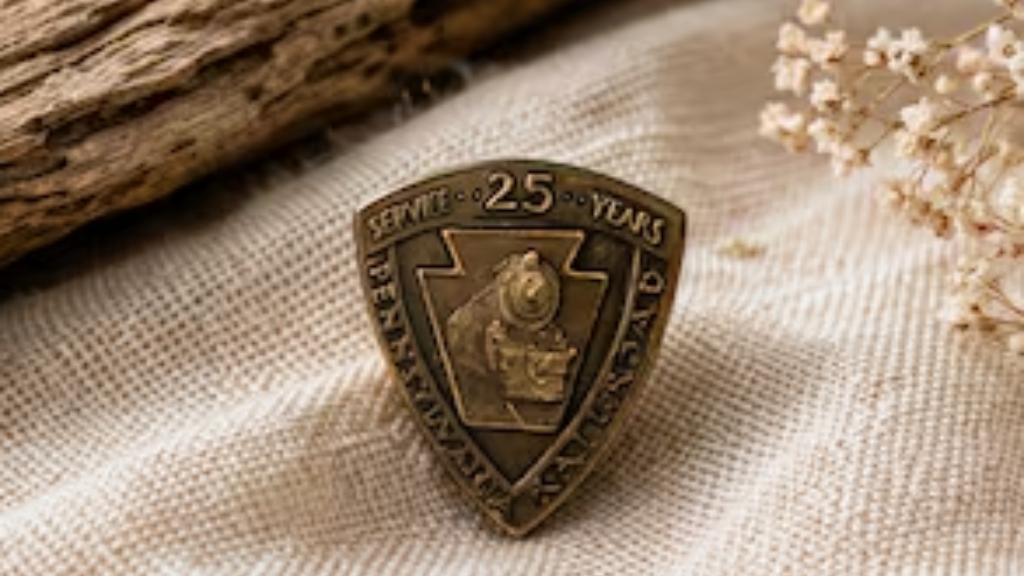
The Pin That Outlives the Tenure
Here’s the final argument for why service and anniversary pins still matter: they’re one of the few recognition objects built to last a whole career — and to be seen for the whole career.
In an economy where the median tenure is 4.1 years, a person who stays twenty-five years is a statistical miracle. Their institutional knowledge, their relationships, their memory of how the company navigated its crises — all of it walks out the door at retirement unless something makes it visible before then. The pin is that something. It’s the visible evidence that staying is a value this organization actually honors, not just claims to.
The conference room clears. The woman sits back down, turns the twenty-five-year pin over once more, and clips it next to the others. Twenty-five years, worn on her chest where everyone can see them — a row of small metals saying what no exit interview ever will: she stayed because staying was seen.
That’s why the service pin endures. It’s not nostalgia for a more loyal era. It’s a practical, affordable, wearable declaration that dedication still counts — in an age when it’s never been rarer.
Decades of dedication, one pin at a time. That’s a tradition worth keeping.