
Table of Contents
After the Siren: How Fire Prevention Week Turned Lapel Pins Into a Public Safety Tool
The siren is the part of the fire service anyone can picture. Truck rolling, lights strobing, neighbors watching from sidewalk. Loud, dramatic, and almost always somebody else’s story.
The work that follows is quieter, longer, and more important. It’s the third grader still wearing the sparkly red badge from last October’s station tour. It’s the smoke alarm battery handed across a kitchen table during a free safety check. It’s the volunteer recruit wearing a small enamel pin on her coat, telling the next neighborhood, the department cared enough to mark this. That second part of the job — the door-knocking, the school visits, the giveaway-table education — has a week on the calendar. It’s what Fire Prevention Week was built for, and in 2026 it’s where the lapel pin quietly does more public-good work per dollar than almost anything else in the toolkit.
Why the Siren Was Never the Whole Job
Fire Prevention Week is the longest-running public health campaign in the United States, made official by President Coolidge in 1925. A century on, the U.S. fire problem is a home problem. The NFPA tracks roughly 1.4 million reported fires annually, with about 249,000 home structure fires — and those home fires account for roughly 75% of all civilian fire deaths, around 3,500 lives a year. Direct property damage runs $12–14 billion annually for home fires alone.
The good news is consistent enough it ought to be plumbing. Working smoke alarms cut the risk of dying in a reported home fire by roughly 55% — the single most effective residential fire-safety intervention of the last half century. The challenge isn’t technology. It’s distribution. NFPA surveys still find roughly 1 in 5 U.S. homes has a smoke alarm that isn’t working. That gap — between the safety that’s available and the safety that’s actually in the ceiling — is exactly what Fire Prevention Week exists to close. It’s where the lapel pin earns its place.
What Fire Prevention Week Is in 2026
In 2026, Fire Prevention Week runs October 4–10, anchored to the Sunday anniversary of the Great Chicago Fire. The NFPA sets the annual theme months in advance. The 2026 theme focuses on lithium-ion battery safety — covering e-bikes, e-scooters, power tools, vapes, and the overnight-bedroom-charging habits behind a documented rise in fast, hard-to-extinguish home fires.
The week’s structure is constant year to year: roughly 29,000 fire departments amplifying a national push, with most public-touch through school visits and station open houses, and one under-recognized third channel — the Community Risk Reduction (CRR) visit, where a firefighter actually shows up at someone’s door. CRR smoke-alarm canvassing in cities like Atlanta, Philadelphia, and Memphis has been documented to drop fire-death rates in targeted neighborhoods by double-digit percentages over multi-year programs. What the resident keeps from that visit is not the brochure. It’s whatever object the firefighter left in their hand as they were walking back to the truck. That object is the pin.
Why a Pin Outlasts a Flyer
Flyers go in the recycling bin. Magnets disappear in a move. Stickers peel off. A pin is what firefighters call retention gear — a small, durable object that migrates somewhere in the home where it gets seen daily: a backpack zipper pull, a kitchen corkboard, a car visor. The reminder fires not because anyone reads it on purpose, but because the eye lands on it every morning while looking for the car keys.
PPAI research has consistently found that roughly 8 in 10 consumers who receive a quality promotional product can recall the brand a full year later — a recall rate most digital channels can’t match. Where a flyer produces one impression, a pin produces hundreds. The same psychology works on the firefighters themselves: a CRR-program pin functions as soft recognition, telling the next neighborhood the department cared enough to mark this. Small, cheap, persistent — and one of the few prevention objects whose placement problem is already solved.
Anatomy of a Good Fire Prevention Pin
A pin for prevention duty needs three things a commemorative coin doesn’t: it must survive a child’s backpack, read at arm’s length, and look like it’s worth something — because the take-home signal “this matters” is the entire reminder value.
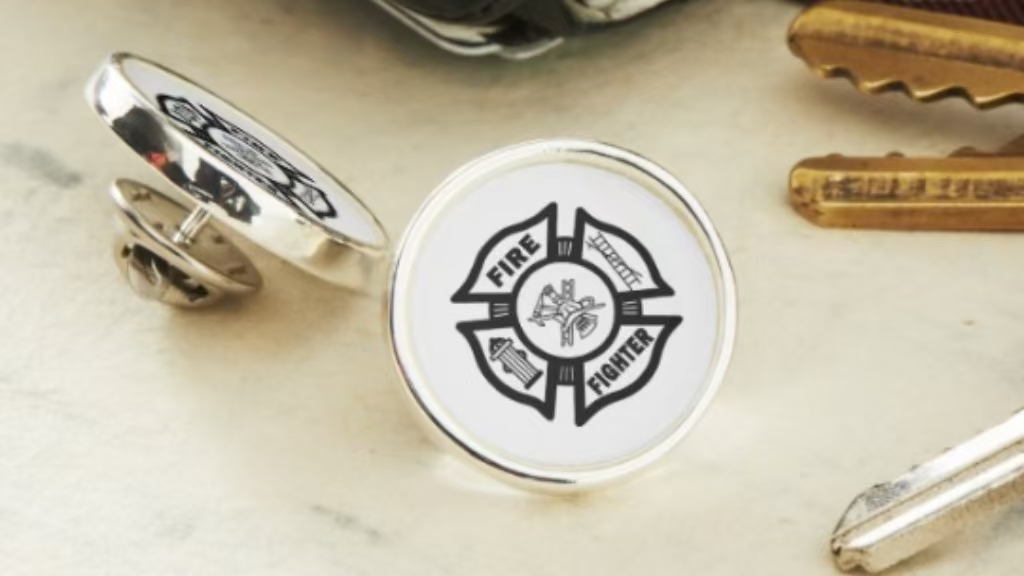
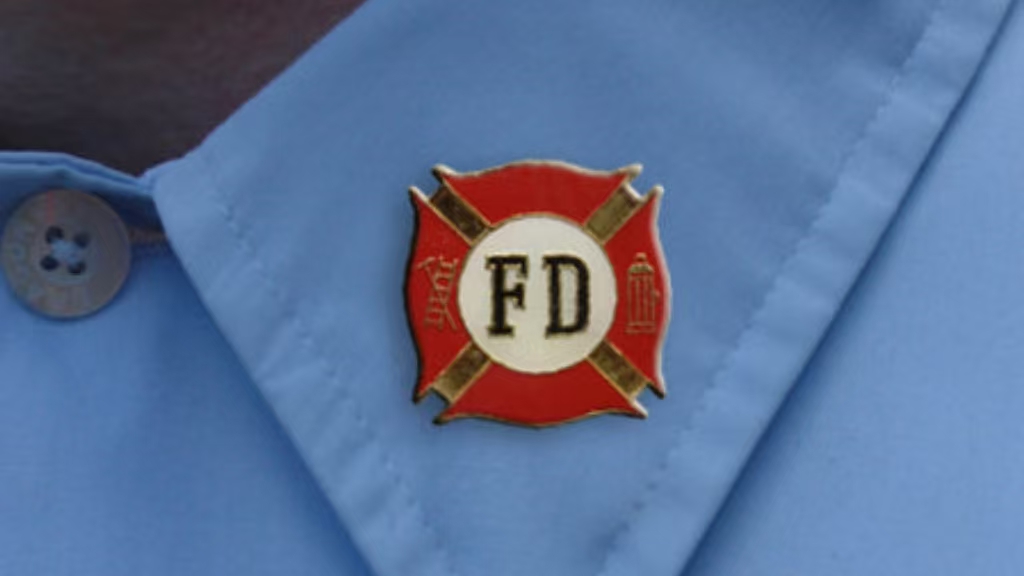
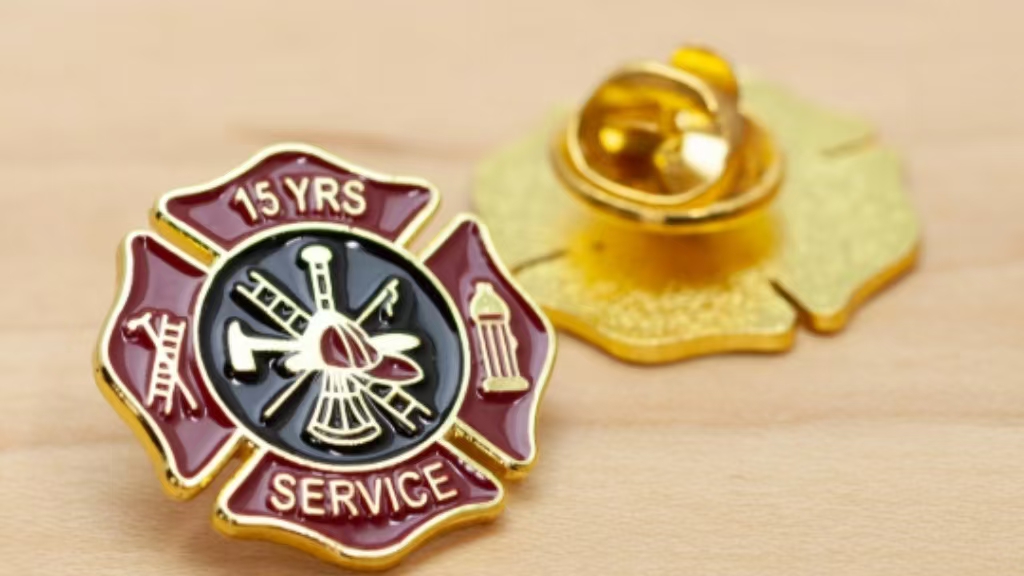
Size and silhouette. Most public-facing FPW pins sit between 1.0 and 1.5 inches in their longest dimension. The Maltese cross dominates American fire iconography for a reason — it reads at thirty feet and signals “fire service” instantly.
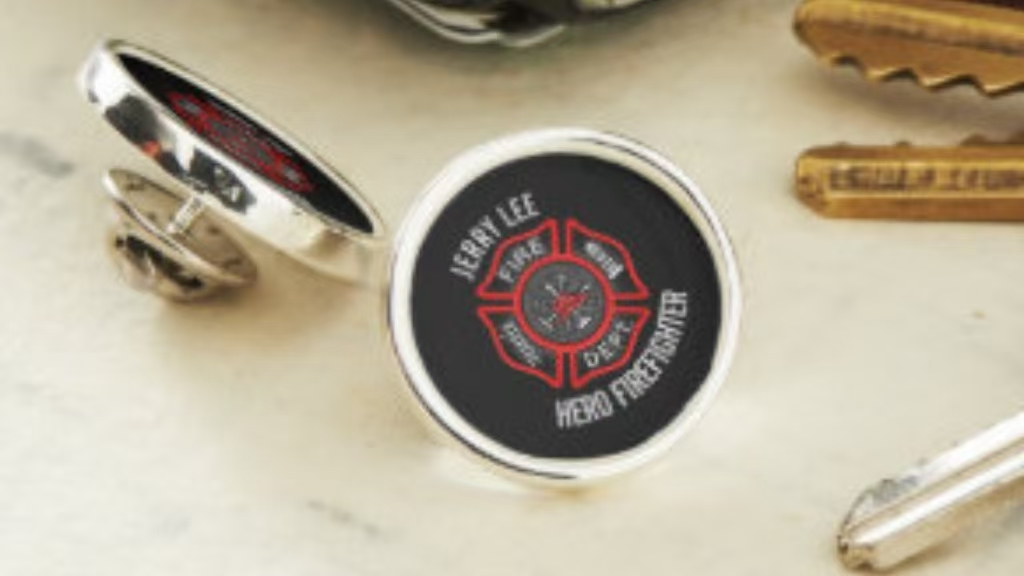
Finish. Soft enamel remains the giveaway workhorse. For higher-end pieces, antique gold or antique silver plating makes the throwaway feel like a service object. Glitter and translucent enamel are the standard for school-visit giveaways because they say “kid” at a glance. Public-facing fire pins lean into red, black, gold, and silver — the colors residents already associate with the service. A translucent red fill or metallic gold catch that reads from three rows back in a school assembly does half the public-safety job on its own.
Backstamp and date. Every FPW pin should carry the year on the back. NFPA, NASA, and the U.S. Mint have proven year-marked small giveaways are collectible at scale — a child who gets the 2026 pin on Monday will be slightly more interested in the 2027 pin next year. The cost difference is essentially nothing. The back can also carry a four-line safety reminder — change smoke alarm batteries, replace units every 10 years, sleep with doors closed, don’t charge lithium-ion devices unattended — laser-etched small enough not to read by accident, legible to anyone who looks.
Attachment. A rubberized clutch back works for adults. For children, an upgrade to a deluxe pin-back with safety rolling clasp is worth the small per-unit cost — it prevents the single most common kid-pin failure: the back springing open inside a backpack. For higher-end recognition and chief pieces, antique plating and 3D relief are the standard — they make a 50-piece run read as a keepsake rather than a giveaway.
What the 2026 Pin Bundle Looks Like
Smart departments don’t order one pin for FPW. They order a small bundle — three to five designs, each with a public-safety job — and stagger them across the week.
Pin Design | Quantity | Public-Safety Job | Wearer |
This-year’s FPW theme | 1,000–5,000 | Take-home reminder; school-visit handout | Kids, residents |
Smoke alarm “10-year change your clock” | 500–2,000 | Fridge / alarm reminder | Residents |
CRR program | 200–500 | Marks the volunteer door-knocking | Firefighters, volunteers |
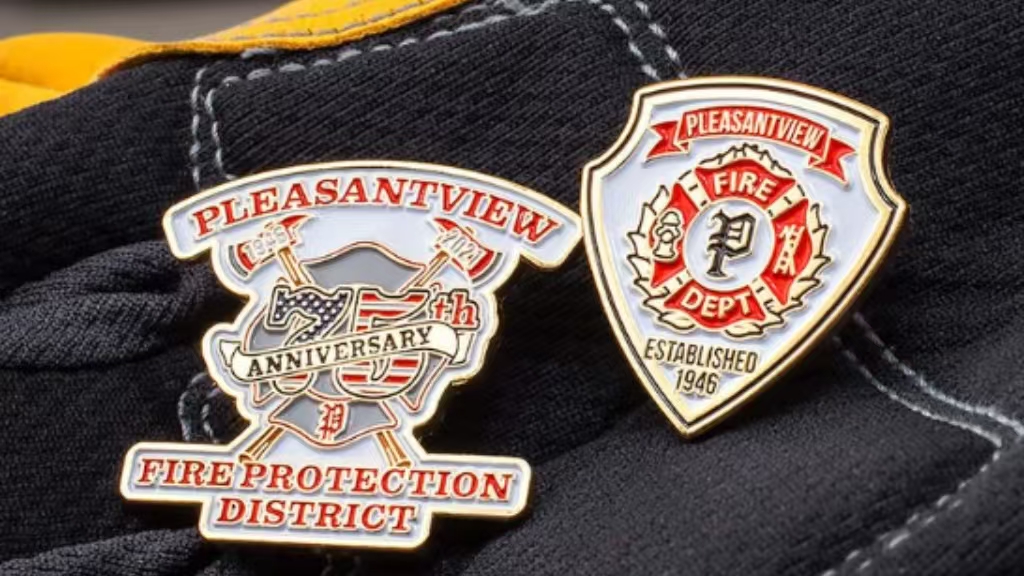
Department shield / station patch | 200–1,000 | Wearable identity at events | Firefighters, explorers |
Chief / anniversary / memorial | 50–200 | Recognition, legacy | Command staff, families |
The point is segmentation. The theme pin is for the public. The CRR pin is for volunteers and crews. The shield is for people on duty at events. A bundle lets every audience get a pin built for their role, instead of one design being asked to do five different jobs.
Who Else Should Be Buying These
The fire department isn’t the only buyer, and the most successful 2026 prevention campaigns are co-branded ones.
Smoke alarm manufacturers and home-security companies have a quiet case for co-branding with local departments. A Kidde × Local FD × Fire Prevention Week 2026 pin distributes through both retail and station channels, gets worn by kids at school, and doubles as an adult giveaway in stores.
School districts and PTAs are an underused pin buyer. A classroom set of 30 pins costs less than a pizza party, lives on backpacks for the school year, and is the rare educational giveaway that doesn’t get thrown away on the bus ride home.
E-bike and micromobility retailers are the most contrarian 2026 buyer. A retailer that sells a scooter and hands over a Fire Prevention Week lithium-ion charging-safety pin — clearly branded, attached to the charger cable, in the box — is doing the exact community risk reduction the fire service wishes it had the budget to do. It costs pennies per unit and says we sold you the thing that could burn your house down, and we care enough to mark that.
The Week Itself: A Five-Day Pin Cadence
Treating FPW as one event is a common pitfall; in practice it’s a five-day rolling set of audiences.
Day | Audience | Pin Type in Use |
Sunday (FPW kickoff) | Civic leaders, press | Department shield, chief pin |
Monday | School visits (K–5) | This-year’s themed kid pin |
Tuesday | Open house / station tour | Theme pin + shield for crews |
Wednesday | CRR smoke-alarm drive | CRR program pin for volunteers |
Thursday | Industry partners, mutual aid | Anniversary / recognition pin |
Friday | Family night, school assembly | All five pins on a giveaway table |
Pairing each day with a specific pin role lets a department hand out different pins on consecutive days — a small detail that materially raises the chance a recipient keeps the pin.
Cost, Lead Time, and the Pitfalls
Fire Prevention Week falls in October, but the production calendar doesn’t. Standard soft-enamel pins from a U.S. or overseas factory typically run 10–14 business days for production after artwork approval, plus shipping. A practical 2026 calendar:
Step | Target Date |
Theme confirmed & artwork started | Within 1 week of NFPA announcement |
Order placed | No later than early August |
Production + QC | Mid-to-late August |
In-hand for kit assembly | Early September |
FPW kickoff events | October 4–10, 2026 |
The avoidable pitfalls:
- Ordering off-theme.Artwork locked in before the NFPA theme drops means reprinting. Wait for the announcement.
- Cheap clutches on kids’ pins.A $0.05 upgrade to a rolling clasp is the difference between a pin that lasts a school year and one lost in March.
- One design for all five days.A single giveaway pin doesn’t segment for stations, schools, CRR drives, and recognition.
- No year stamp.A bare Maltese cross is generic. One with 2026 on the back is a collectible.
Budget anchors for 2026, based on mid-tier U.S. and overseas factories: a soft-enamel kid-pin typically lands in 0.45–1.20 per pin at 1,000 quantity; a polished brass or hard-enamel recognition pin in 1.20–2.80 at 200; a premium die-struck shield or chief anniversary pin in 2.50–5.50 at 100.
The Real Public-Safety Argument
NFPA’s research on smoke-alarm canvassing programs consistently shows that home visits paired with alarm installation can drop fire-death rates in targeted neighborhoods by 15–25% over multi-year programs. The 55% reduction in death risk from working smoke alarms is the population-level figure — meaning the gap between “everyone has a working alarm” and “almost everyone does” is the gap between thousands of preventable deaths.
What closes that gap is not a brochure. It’s a person at the door, and a small object in her hand that signals this is real, this is the fire department, this matters. The lapel pin is that object: cheaper than a brochure, more permanent than a magnet, uniquely suited to a job that is not information transfer but reminder persistence. The pin lives where the eye lands on the way out the door, and every morning it quietly does the work that the siren can’t.
After the siren — that’s the work. And in 2026, more of it than ever is being done in enamel.