
Table of Contents
Trick, Treat, and Metal: Inside the Halloween Challenge Coin Craze
It happens at the merch tent, usually around 9:50 p.m., right after the last hayride of the night comes back in.
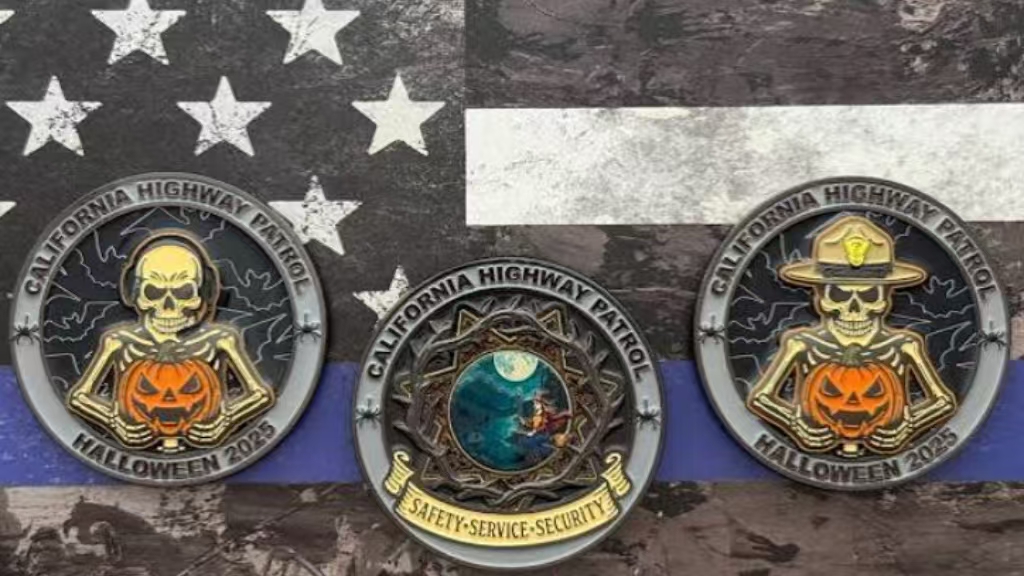
A family of four is standing at a folding table under a string of orange lights. The kid — maybe nine, still wearing the skeleton hoodie — is holding a two-inch disc of metal like he’s not sure what to do with it. Black nickel, jack-o’-lantern in raised copper, 047/300 stamped along the edge. He turns it over twice and asks the one question that actually matters:
“Will there be another one next year?”
The guy behind the table says yes before he’s finished asking. That question — asked by a nine-year-old holding the first thing he’s ever owned with a serial number on it — is the entire Halloween challenge coin trend in one sentence. Not is this cool, but is this a set.
Halloween 2026 is the year that question starts getting asked in a lot of places at once, and the reason isn’t mysterious. The holiday got bigger, longer, and more adult; the businesses built on it started looking for ways to sell a keepsake; and a small piece of metal turned out to be the cheapest way to turn one Saturday into an annual habit.
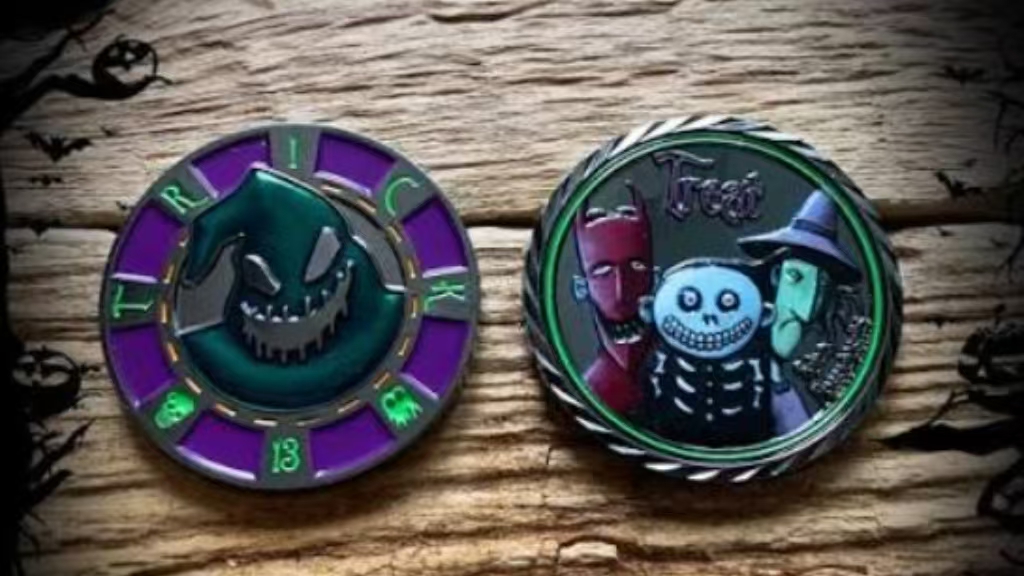
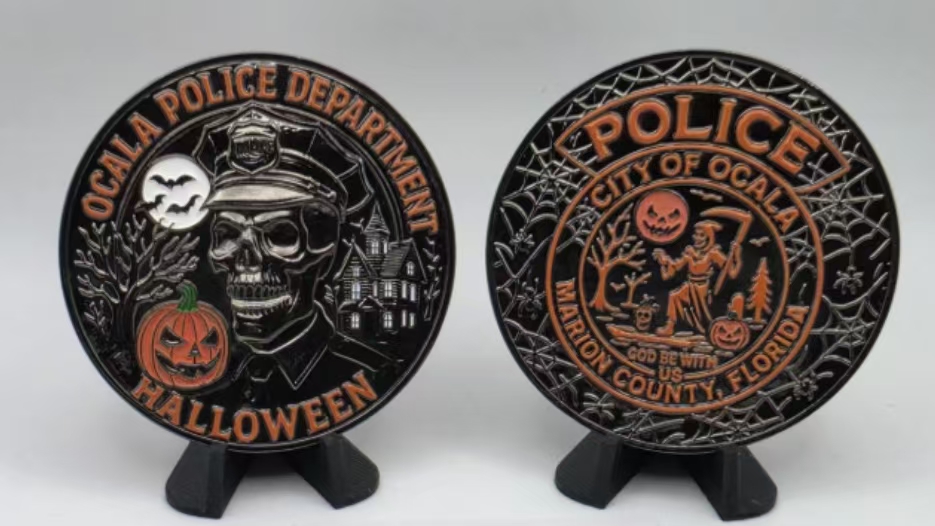
Halloween Stopped Being a Night
The holiday’s economics have been drifting this way for a decade, and 2026 is where the drift becomes obvious.
U.S. Halloween spending is projected to reach **13.5 billion** this year — a new record, up from last year’s record of 13.1 billion — with 74% of consumers planning to celebrate and average per-person spend at 115.14. Candy remains the most-purchased category at 96% of shoppers and 4.1 billion, but look at what sits behind it: decorations at 78% and 4.3 billion, costumes at 71% and 4.4 billion. Decorating now out-draws costuming. Halloween isn’t a night you eat something; it’s a month you build something.
And the build starts earlier every year. 49% of shoppers now begin buying in September or earlier — up from 34% a decade ago. Hershey’s 2026 State of the Season report, done with Morning Consult, put numbers on the feeling: 55% of parents say they’re in “Halloween mode” before October starts, 67% of parents have already bought Halloween candy in summer, and 53% of Gen Z know the word Summerween, a term that went from roughly 14,000 social mentions in 2023 to 65,000 in 2025.
The same report found trunk-or-treating is now embraced by 20% of Halloween participants, and asked what makes a perfect Halloween block, the top answers weren’t about candy — 41% said a street where everybody participates, 39% said streets full of trick-or-treaters.
Read that as a manufacturer and it’s a clear instruction: Americans are buying participation, and participation needs props.
The Industry That Turned Props Into Products
The people who figured this out first weren’t retailers. They were the haunted attraction industry — a sector that has quietly professionalized into something closer to a seasonal theme-park business than a bunch of guys in masks.
There are roughly 3,500 haunted attractions operating in the U.S. each season, generating about 917 million** in annual revenue and supporting **10,200 full-time jobs**. The average visitor spends around **68 per visit on tickets, food, and merchandise, stays 25 to 30 minutes, and visits two to three attractions per season. 65% of attendees are between 18 and 34. The trade association certified a record 74 Top Haunts for 2026, up from 67 in 2025, spanning 27 states — and the top 10% of attractions each draw more than 50,000 visitors a year.
That’s a business with a hard problem: it has roughly four weekends to make its year, tickets are price-sensitive, and the crowd skews young enough that a T-shirt is a hard sell. Merchandise is the only lever left that raises per-head revenue without raising the gate price — and a coin is the best merchandise SKU this industry has ever found. It’s small, impossible to counterfeit convincingly, cheap at volume, and it carries the one thing a haunted house actually has to sell: proof you made it through.
Where the craze lives | Who’s buying | Typical run | Why it repeats |
Haunted attractions & hayrides | 18–34 crowd, repeat visitors | 200–500, numbered | VIP upsell + set completion |
Trunk-or-treat & church events | Families with kids | 200–1,000, simple design | Annual dated handout |
Fire/police safety nights | Departments, community affairs | 100–500 | Year-over-year reorder |
Halloween towns & civic festivals | Visitors, locals, collectors | 300–1,000, dated | Town pride + tourism revenue |
Breweries, taprooms, bars | Regulars, 25–44 | 50–200, functional edge | Limited drop culture |
Families & friend groups | Households, group costumes | 20–100 | Annual tradition, high emotion |
The Towns That Started Minting Their Own
The most interesting development of the last two seasons is where the coins are coming from: not companies, but places.
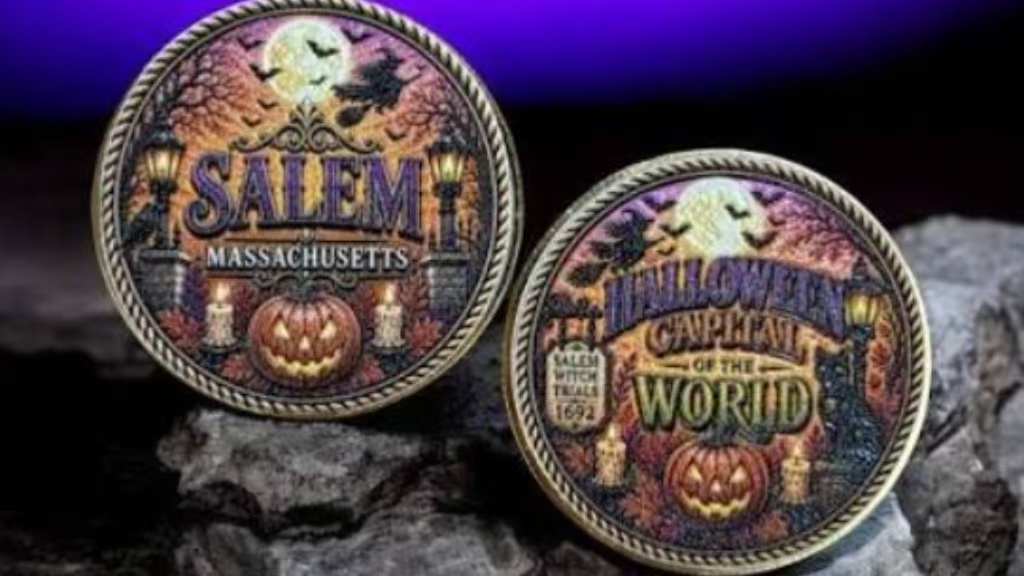
Salem, Massachusetts runs Haunted Happenings for the whole month of October — October 1 through 31 — and 2026 is its 44th season, landing in the same year as the city’s 400th anniversary. Hundreds of thousands of visitors come through a compact downtown that fills fast. A dated 2026 coin, or a 400th-anniversary edition, is the kind of object that sells twice: once to the person who wants proof they were there in the anniversary year, and again next October to someone who missed it.
Anoka, Minnesota — self-declared Halloween Capital of the World, holding a citywide celebration every year since 1920 — runs the whole thing through a nonprofit whose gift shop proceeds go back into local schools and scholarships. That structure is a coin program waiting to happen, and in many ways already is: an annual dated coin sold through a civic gift shop funds the thing it commemorates. The Grande Day Parade alone draws more than 150 floats.
St. Helens, Oregon has spent every October since 1998 leaning into being the real-life Halloweentown. The Great Jack O’Lantern Blaze in Croton-on-Hudson, New York — season 22, 7,000-plus hand-carved pumpkins, 44 nights from September 18 to November 8, tickets from around $24 — is the same model with better lighting.
These places have one thing in common: they sell memory, and memory needs an object.
Why a Coin, and Not Another Keepsake
Challenge coins come out of a military tradition with one non-negotiable rule: a coin is earned, never bought. You get it from someone who saw what you did. Carrying it is proof you belong. And if someone calls a coin check, you’d better have it on you.
Halloween is a near-perfect civilian fit, because the holiday already runs on earned status. You walked the whole route. You made it through the haunt. You showed up in the group costume. Nobody has to explain the rules.
But “earned” alone doesn’t make a craze. A craze needs a loop, and the loop here has five parts.
- It’s dated.A 2026 coin is useless in 2027 — which is exactly why 2027 has to happen.
- It’s numbered.047/300is a different psychological object than a coin. Serial numbers create completion behavior automatically, at zero extra cost.
- It’s photographable.Glow enamel in a dark room is the most shareable thing in the entire holiday, and the coin is small enough to be in every photo from the night.
- It’s cheap to make and expensive to receive.Unit cost at volume runs a fraction of what the object feels like in the hand. Weight reads as value; nobody has to be told.
- It survives.The costume is outgrown by next year. The candy is gone by November 3. The decorations go into a bin. The coin goes on a nightstand for eleven months and then reminds someone to buy a ticket.
There’s also a real secondary market underneath all of this, worth being honest about. Challenge coins trade on eBay at scale, where common coins land in the 5–15 range and scarce, unit-issued examples sell for 25–500, with exceptional pieces hitting four figures at auction. Custom coins made for broad sale generally don’t appreciate — and that’s fine, because appreciation was never the mechanism. The mechanism is the set.
What makes a Halloween coin collectible | What makes it forgettable |
Dated year on the face | Generic art with no year |
Numbered edge (e.g., 047/300) | Open-ended run, no scarcity |
One design per year, never reissued | Same coin sold for three years |
Ties to a specific place or event | Clip-art pumpkin anyone could order |
Deep 3D relief or sculpted detail | Flat, single-color, novelty-grade |
A rule attached — earned, not sold | Sold at a checkout with no story |
What the Coins People Keep Have in Common
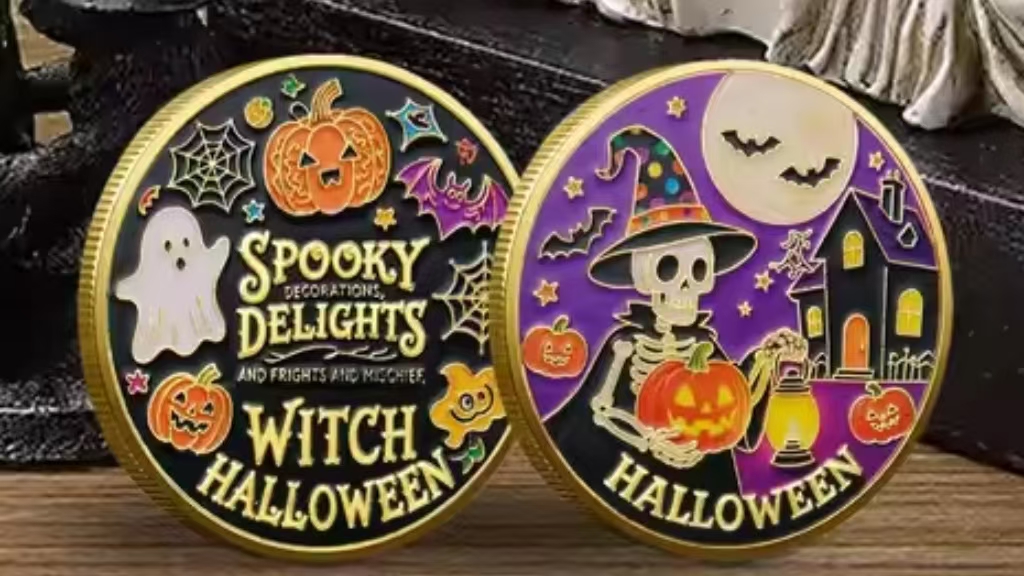
The coins that get kept share a short list of traits: matte black or antique plating with a second metal for contrast; glow-in-the-dark enamel used selectively — eyes, moon, lettering — rather than flooding the whole face; deep 3D relief for anything with a skull, a raven, or a house in it; and a 1.75-inch size that reads substantial in an adult hand without being bulky in bulk.
Two warnings. Glow enamel and matte black are the two finishes most likely to sell out in October — order before the rush, not during it. And pick one aesthetic lane: Halloween taste has split into fall-forward, haunted-house, and classic camps that each pull roughly a quarter of shoppers, and a coin that tries to be all three looks like clip art.
Thirty-Three Days and a clear story, it's the one they'll find.
Here’s the arithmetic, and it is tight. It’s late September. Halloween is Saturday, October 31 — about 33 days out — and standard custom coin production runs four to six weeks including artwork, molding, production, and shipping.
Which means the comfortable window has essentially closed, and you’re choosing between two lanes.
Lane | What it looks like | Best for |
Standard (already late) | 4–6 weeks, full finish range, lowest unit cost | 2026 is a test run; you’ll reorder in January for 2027 |
Express | UV-printed coins in as little as 1–3 days of production | You need coins in hand by October 25 |
Plan-ahead | Order in January for next October | Annual numbered series, best price, no rush fees |
If you’re reading this in the last week of September, the honest recommendation for most buyers is the third lane with an express order for this year: mint a small express run now to see whether your crowd actually wants one, then place the real order in January at a third of the per-unit rush cost and none of the stress.
One more number worth planning against: 47% of Halloween shoppers are now using AI tools to plan the holiday — brainstorming ideas and researching products. People are arriving with a picture in their head of what they want. If your coin exists on the internet with clear photos and a clear story, it’s the one they’ll find.
How Crazes Actually Start
Nobody is going to announce the Halloween challenge coin trend. There’s no trade body for it, no industry report, no keynote. That’s how these things always work — a merch tent in Ohio, a church parking lot in Minnesota, a taproom in Oregon, all arriving at the same object independently within about eighteen months of each other, because the conditions were the same everywhere: a holiday that had become a season, an industry that needed per-head revenue, and a crowd that wanted something to keep.
The test of whether it’s real comes next October. If the kid holding 047/300 comes back asking for 2027, it’s a tradition. If he doesn’t, it was a party favor.
Everything about the economics says he comes back.