
Table of Contents
Forged in Fire: Why Challenge Coins Are the Ultimate Badge of Honor for Fire and EMS Crews
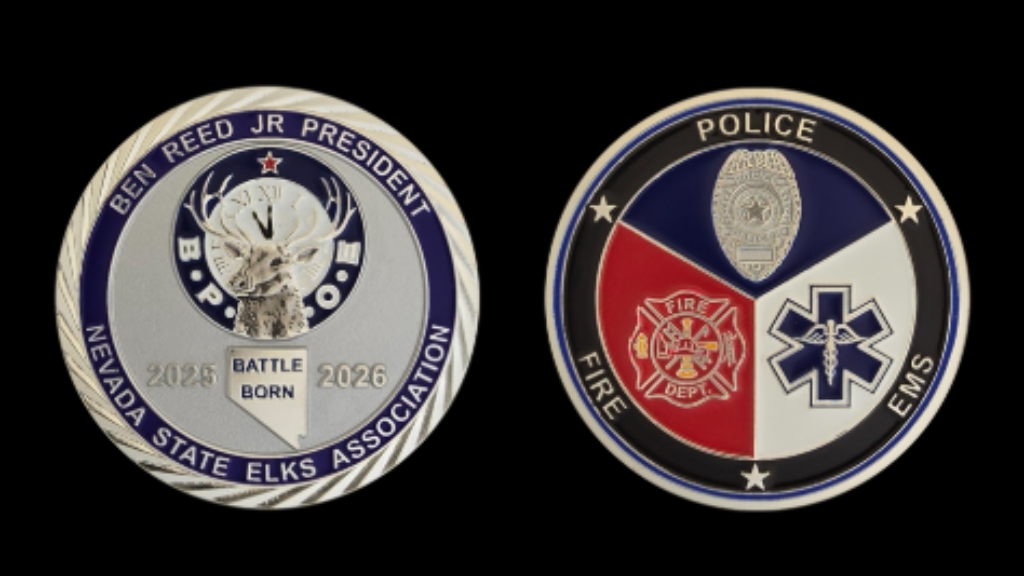
Walk into any firehouse in America and you’ll find them — tucked into turnout coat pockets, lined up on desk shelves, framed behind glass in the dayroom. They’re heavier than they look, cold to the touch at first, and warm in the hand after a few seconds. Challenge coins have become as much a part of fire and EMS culture as the Maltese Cross, the station alarm, and the pot of coffee that never empties.
But unlike a badge or a uniform patch, a challenge coin isn’t issued by a department. It’s earned. It’s given. And in the high-stakes, high-trauma world of emergency response, that distinction matters.
This article breaks down how challenge coins migrated from military squadrons to fire stations and EMS crews, why they’ve become the recognition tool of choice in first responder culture, what design trends are dominating the market in 2026, and what departments need to know before placing an order.
From Military Boots to Fire Boots: The Cultural Pipeline
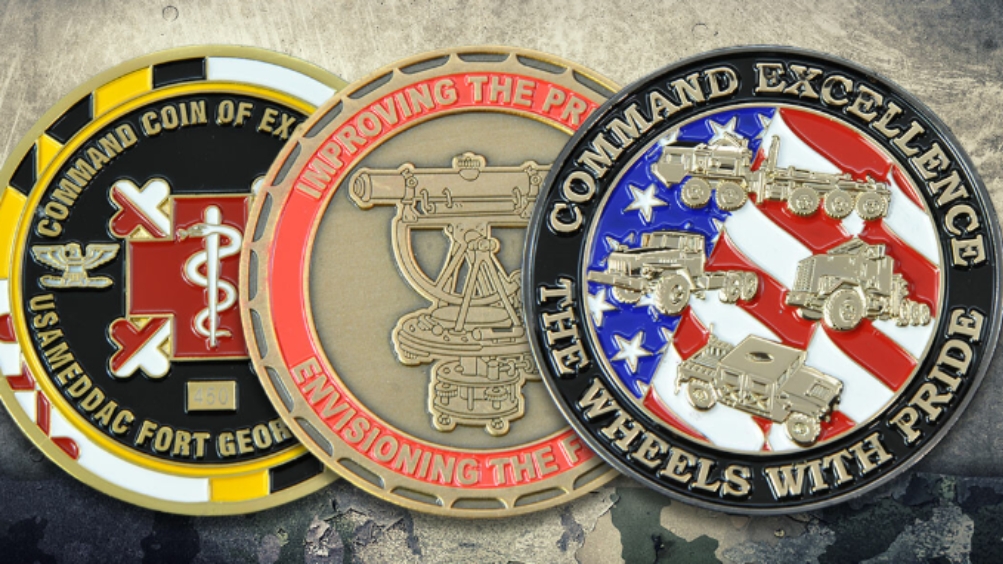
The challenge coin tradition is widely traced to World War I, when a wealthy lieutenant commissioned bronze medallions for his aviation squadron. The story goes that a captured airman used his coin to prove his identity to French forces, narrowly avoiding execution. Whether the legend is fully accurate or not, the tradition took root: military units began striking coins to mark membership, build morale, and create a tangible bond between people facing mortal danger together.
The pipeline from military service to first responder work isn’t just career movement — it’s cultural transmission. After Vietnam and the Gulf War, thousands of veterans transitioned into police, fire, and EMS roles. They brought with them the traditions that had sustained them in uniform: the coin check, the unit identity, the quiet handshake that passes a coin from one palm to another.
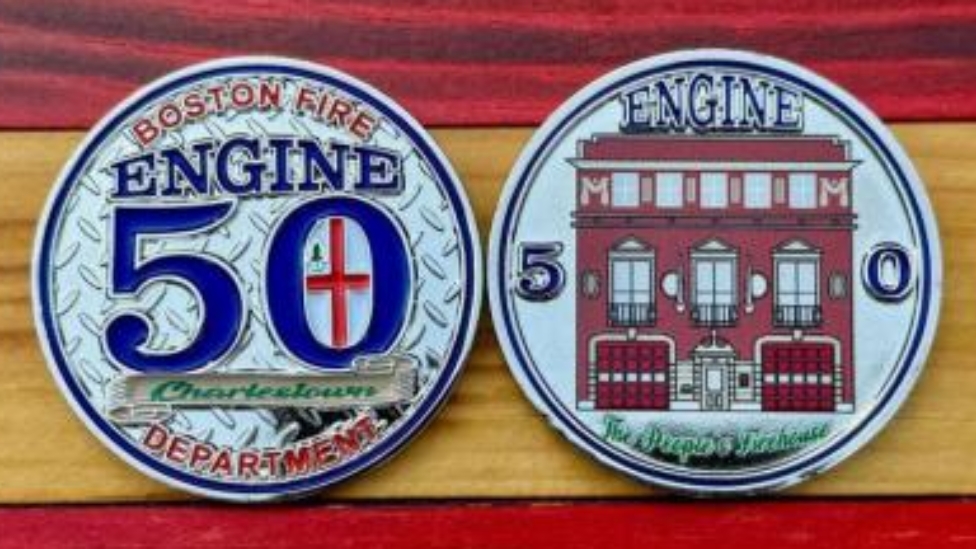
The first documented fire department challenge coins appeared in the 1980s and 1990s, commissioned to commemorate significant incidents — major structure fires, line-of-duty deaths, heroic rescues. They recognized achievement and valor in situations where standard awards felt insufficient. Police departments followed similar patterns. EMS and paramedic services adopted the tradition more informally but no less meaningfully, recognizing critical incidents, mass casualty responses, and years of service.
Why did the tradition transplant so successfully? Because first responder work shares the same fundamental characteristics as military service: exposure to danger and trauma, reliance on unit cohesion, and a culture that values both formal recognition and informal respect. The tangible weight of a coin acknowledges the intangible sacrifice — the stress, the fear, the 3 a.m. calls that don’t make the news.
Why Fire and EMS Crews Value Coins Over Other Recognition
In professions where supervisors rarely witness the most challenging moments, traditional awards fall short. A paper certificate doesn’t capture what it felt like to pull a child from a burning building at 2 a.m. A plaque on a wall doesn’t acknowledge the paramedic who held a dying patient’s hand because there was nothing left to do medically.
Challenge coins fill that gap. They serve four critical functions in fire and EMS culture:
1. Tangible Recognition of Intangible Sacrifice
A coin is physical. It has weight, texture, and permanence. When a battalion chief hands a firefighter a coin after a difficult call — not during a formal ceremony, but quietly, at the kitchen table over coffee — that moment carries more weight than any certificate. The coin becomes a physical anchor for a memory that words can’t fully capture.
2. Unit Identity and Camaraderie
Fire stations are families. Shift crews spend 24 to 48 hours together, cooking meals, running calls, sleeping in the same building. A station-specific coin reinforces that bond. Many departments design unique coins for each station, each shift, each specialized unit — heavy rescue, hazmat, wildland, ALS transport. The coin says: you were part of this.
3. Peer-to-Peer Recognition
Not every coin comes from the chief. One of the most powerful traditions in fire and EMS culture is the peer exchange — one firefighter or medic handing a coin to another after a particularly tough shift, a successful rescue, or years of working together. These coins often carry the deepest meaning because they come from someone who understood exactly what the moment cost.
4. Commemoration and Remembrance
Memorial coins honor fallen firefighters and EMS providers. These coins often feature the member’s badge number, end-of-watch date, and the Thin Red Line. They serve as legacy pieces for families and colleagues, providing tangible comfort in the face of loss. According to FEMA, 931 firefighters died in the line of duty between 2015 and 2026 — and behind each of those numbers is a story that a coin can help preserve.
The Language of Fire and EMS Coins: Symbols and Meanings
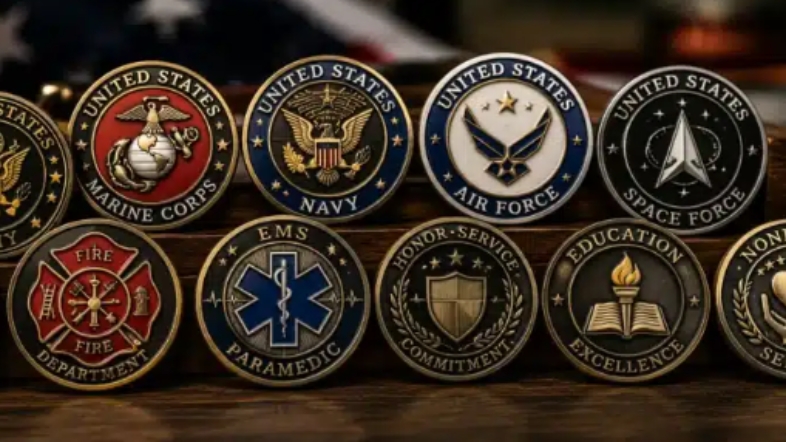
Fire and EMS challenge coins speak a visual language that insiders read instantly. Every symbol carries weight, every color choice communicates values. Understanding this vocabulary is essential for designing a coin that resonates with its recipients.
Symbol | Meaning | Common Use |
Maltese Cross | Fire service emblem; eight points represent loyalty, courage, honor, dexterity, explicitness, sympathy, perseverance, generosity | Primary fire department coins |
St. Florian | Patron saint of firefighters; protection and faith | Spiritual-themed coins, gift coins |
Star of Life | Six-pointed star representing the six stages of EMS: detection, reporting, response, on-scene care, care in transit, transfer to definitive care | EMS and paramedic coins |
Thin Red Line | Firefighter solidarity, sacrifice, remembrance of fallen | Memorial coins, support coins |
Crossed Axes | Readiness, firefighting tools, manual skill | Department badges, rank insignia |
Fire Helmet | Protection, firefighter identity | Station logos, memorial coins |
Phoenix | Rising from ashes, rebirth, resilience | Department mottos, post-incident coins |
Scramble/Clamshell | EMS cross with staff and serpent | Medical service identification |
Color choices are equally deliberate. Fire red (PMS 186 C) signals courage and sacrifice. Gold plating conveys excellence and honor. Antique bronze or black nickel finishes provide a rugged, professional look that stands up to daily carry. Navy blue reflects uniform colors and professionalism. White represents purity of purpose.
When Coins Are Presented: Occasions and Protocols
Fire and EMS challenge coins aren’t handed out casually. Each presentation carries specific meaning, and the context of the exchange matters as much as the coin itself. The table below outlines the most common occasions for coin presentations in first responder culture.
Occasion | Typical Recipient | Who Presents | Design Focus |
Academy graduation | New firefighters/EMTs | Academy instructors | Academy badge, class number, motto |
Promotion | Newly promoted officers | Chief or command staff | Rank insignia, new title, date |
Years of service | Career milestones (5, 10, 20+ years) | Department leadership | Years served, department seal |
Exceptional incident response | Crew members who handled a major call | Incident commander or chief | Incident date, call type, station number |
Retirement | Retiring members | Chief at retirement ceremony | Career span, badge number, “End of Watch” |
Line-of-duty death memorial | Family and crew of fallen member | Department, often chief | Member’s name, EOW date, Thin Red Line |
Inter-agency exchange | Visiting crews, mutual aid partners | Peer-to-peer | Department seal, reciprocal design |
Station opening | Entire station crew | Chief or city officials | Station number, establishment date |
The presentation protocol itself carries meaning. A coin is traditionally presented with a handshake, the coin placed in the recipient’s palm — sometimes slapped into it, a gesture symbolizing the transfer of trust. The presentation is almost always accompanied by a narrative: why the individual is receiving it, what they did, what it meant. That story becomes inseparable from the coin’s value.
Design Trends in 2026: What Fire and EMS Coins Look Like Now
The challenge coin market has evolved significantly, and fire/EMS coins have evolved with it. The global promotional products market, which includes custom challenge coins, is projected to reach 22.44 billion in 2026** (Business Research Insights), with challenge coins representing an estimated **380–420 million segment. First responder orders remain a core driver of that segment, alongside growing corporate and commemorative demand.
Several design trends are shaping fire and EMS coins in 2026:
3D Deep Relief Sculpting
Flat, 2D designs are giving way to deep-mold 3D sculpting that creates tactile, dimensional surfaces. For fire and EMS coins, this means Maltese Crosses that rise from the surface, fire helmets with visible texture, and Star of Life symbols with sculpted serpents. The depth adds a premium feel that recipients immediately notice.
Glow-in-the-Dark Enamel
One of 2026’s most unexpected trends is also one of the most practical for first responders. Glow-in-the-dark enamel fills absorb light during the day and emit a soft blue, green, or white glow in dark environments. For night-shift crews — which describes most fire and EMS personnel — this feature has both aesthetic and functional appeal. A coin that glows in a turnout coat pocket or on a darkened apparatus floor carries a certain poetry.
Dual-Metal Finishes
Single gold or silver plating is no longer the default. Dual-metal coins combine contrasting finishes — bright gold and matte silver, antique bronze and black nickel — on the same coin surface. This layered plating highlights key design elements without increasing coin size, creating visual drama that suits the prestige of fire and EMS recognition.
Serialized and Numbered Editions
Limited-edition runs with individual serial numbers are gaining traction, particularly for memorial coins and anniversary commemoratives. A coin stamped “047 of 250” carries an implicit scarcity that elevates its perceived value. When combined with QR code integration — linking to a digital certificate of authenticity or a memorial page — the coin bridges physical tradition and digital verification.
Custom Shapes Beyond the Circle
Round coins remain standard, but fire and EMS departments are increasingly opting for shield shapes, badge silhouettes, axe-crossed outlines, and Maltese Cross profiles. These custom shapes provide immediate visual recognition and differentiate the coin from generic round tokens.
Tactical and Vintage Finishes
Matte black coatings, anodized aluminum accents, and laser-etched textures convey durability and purpose — a natural fit for fire service aesthetics. On the other end of the spectrum, soft enamel with vintage distressing creates an antique, storied appearance that resonates with departments celebrating long histories.
Memorial Coins: When Metal Becomes Memory
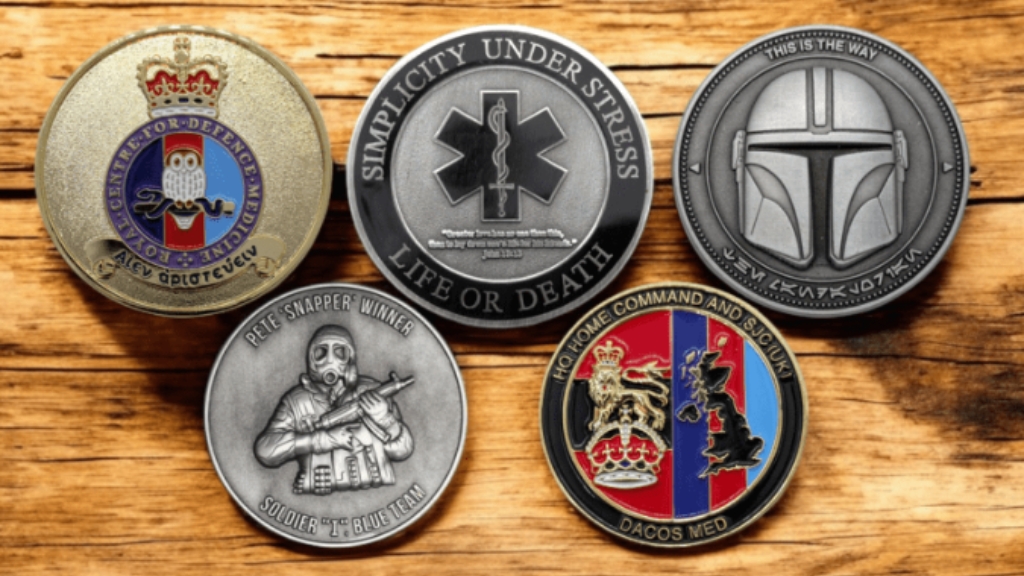
No application of the challenge coin tradition is more solemn than the memorial coin. When a firefighter or EMS provider dies in the line of duty, the coin transforms from a token of affiliation into a vessel of collective grief and remembrance.
Memorial coins typically feature the member’s name, badge number, end-of-watch date, and the Thin Red Line. Some departments incorporate portrait silhouettes, apparatus imagery, or personal mottos. The manufacturing process often involves close collaboration between department representatives and the coin designer, with particular attention to materials and finishes that reflect the gravity of the occasion.
These coins serve multiple purposes simultaneously: they honor the fallen, support grieving families through fundraising proceeds, and provide tangible comfort to colleagues struggling with loss. In a profession where 931 firefighters died in the line of duty between 2015 and 2026 — and where the emotional toll of each loss ripples through entire stations — memorial coins offer something that words and formal ceremonies cannot: a physical object that can be held, carried, and passed down.
The tradition extends beyond line-of-duty deaths. Coins commemorate significant incidents — multi-alarm fires, mass casualty events, natural disaster responses — that leave lasting marks on the crews who responded. A coin marking the anniversary of a major wildfire deployment or a historic flood response serves as both recognition and processing, a way of saying: we were there, we did the work, and we carry it with us.
The Numbers Behind the Tradition
The fire and EMS challenge coin market exists within a broader ecosystem of first responder culture and promotional products. Understanding the scale of that ecosystem helps contextualize why coins matter.
Metric | Figure | Source |
Total U.S. firefighters (career + volunteer) | ~1,041,200 | NFPA Fire Experience Survey, 2023 |
U.S. career firefighters | ~364,300 | NFPA, 2023 |
U.S. volunteer firefighters | ~676,900 | NFPA, 2023 |
U.S. full-time EMS workers (paramedics + EMTs) | 282,900 | U.S. Bureau of Labor Statistics, 2026 |
U.S. fire departments | 29,000+ | NFPA |
Firefighter line-of-duty deaths (2015–2026) | 931 | FEMA |
Global promotional products market (2026) | $22.44 billion | Business Research Insights |
Challenge coin segment within that market | $380–420 million | Industry analysis, 2026 |
Corporate challenge coin adoption growth (2023–2025) | 34% | PPAI industry surveys |
Structure fires in the U.S. | Every 93 seconds | NFPA |
These numbers tell a story of scale. Over 1.3 million firefighters and EMS professionals serve across more than 29,000 departments in the United States alone. Each of those departments has its own culture, its own history, its own moments worth commemorating. The challenge coin market — nearly half a billion dollars and growing — exists because those moments demand something more permanent than a handshake and more personal than a certificate.
How to Order Fire and EMS Challenge Coins: A Practical Guide
For departments, union locals, or station officers considering a coin order, the process is more straightforward than it once was, but the design decisions still require care.
- Define the Purpose.Is the coin for a graduation, a promotion, a memorial, a station identity, or a specific incident commemoration? The purpose drives every subsequent decision — shape, symbols, text, finish, and quantity.
- Choose Your Symbols.Reference the symbol table above. A fire department coin without a Maltese Cross feels incomplete. An EMS coin without a Star of Life lacks context. Consider department-specific imagery: station numbers, apparatus designations, regional landmarks, or unit mottos.
- Select Materials and Finishes.Zinc alloy with gold or silver plating is the industry standard — durable, cost-effective, and suitable for daily carry. For premium coins, solid brass at 3.5–4mm thickness provides the heft that first responders expect. Antique bronze and black nickel finishes convey the rugged aesthetic that fire and EMS cultures favor.
- Consider 2026 Add-Ons.Glow-in-the-dark enamel for night-shift units. QR codes linking to memorial pages or department histories. Serialized numbering for limited editions. Custom shapes — shields, Maltese Cross profiles, badge silhouettes — for immediate visual identity.
- Order the Right Quantity.Most manufacturers have low minimums (50–100 pieces), but unit pricing drops significantly at 300+ pieces. For station coins, order enough for every current member plus a buffer for future hires and exchanges. For memorial coins, consider the family, the crew, and the broader department.
- Respect the Protocol.Plan how and when the coins will be presented. A coin handed across a kitchen table after a tough call carries different weight than one distributed at a formal ceremony. Both are valid. Both matter. The key is intentionality.
The Coin That Stays
In a profession defined by what burns and what remains, the challenge coin is what remains. It doesn’t melt. It doesn’t fade. It outlasts the shift, the call, the career. It sits in a pocket through a 24-hour rotation, gets pulled out years later by a retired firefighter showing their grandkids what they did, and ends up in a shadow box on a hallway wall where it catches the light every morning.
That’s why fire and EMS crews value them. Not because they’re expensive or elaborate — many of the most meaningful coins are simple, even crude. They’re valued because they represent something that can’t be bought: the trust between people who run toward danger together, the recognition of moments that don’t come with paperwork, and the permanent marking of a career spent in service.
In 2026, as the challenge coin market continues to grow and design technology pushes the boundaries of what’s possible, the core tradition remains unchanged. A coin is struck. A story is told. A hand reaches out. And in a firehouse somewhere in America, a piece of metal becomes a memory that someone will carry for the rest of their life.
That’s not a trend. That’s a tradition. And in fire and EMS culture, tradition is everything.