
Table of Contents
From Campaign Trails to the Semiquincentennial: The Political Lapel Pin's 2026 Renaissance
There are years when a lapel pin is just a lapel pin. And then there is 2026 — a year when two of the most powerful forces in American civic life converge on a single, half-inch piece of metal: a hotly contested midterm election cycle and the Semiquincentennial, the 250th anniversary of the United States. Separately, each would guarantee a surge in demand for political pins. Together, they are creating what manufacturers, campaign strategists, and collectors are already calling the most significant moment for political lapel pins since the post-9/11 patriotism boom.
The signs are everywhere. The U.S. Mint’s 2025 Silver Eagle bearing an Army 250th privy mark sold out within hours and now trades above $200 on the secondary market. Campaign suppliers are booking production slots six months in advance. Etsy searches for “1776–2026” pins have climbed sharply since late 2025. The political lapel pin — a fixture of American public life for over half a century — is not just back. In 2026, it has become a cultural artifact, a fundraising instrument, and a collector’s commodity all at once.
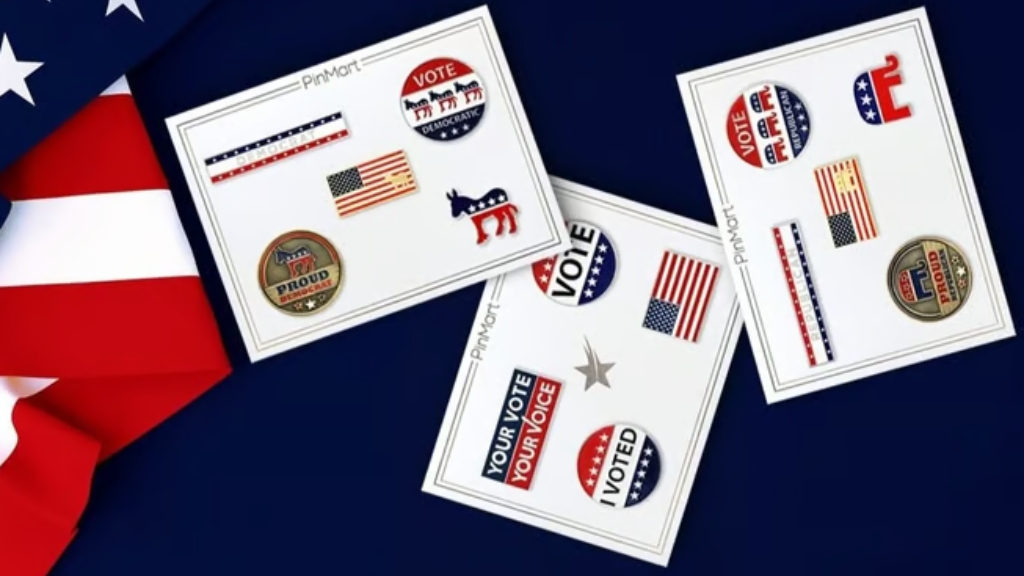
A Brief History: From the Battlefield to the Oval Office
To understand why 2026 matters so much for the political pin, it helps to understand how the tradition began. The American flag did not become a symbol of individual patriotism until the Civil War, when Northerners began displaying it on homes and businesses as a show of support for the Union. But the flag lapel pin as we know it is surprisingly young. Flag-related jewelry was virtually nonexistent for men or women before the 1950s; one might find the occasional flag brooch or formal tuxedo button, but a standardized pin worn on the lapel was rare.
That changed with Richard Nixon. Historians generally credit Nixon as the first U.S. president to make the American flag pin a regular feature of his attire. According to flag memorabilia collectors, the inspiration came from an unlikely source: the 1972 Robert Redford film The Candidate, in which Redford’s character wears a small flag pin on his suit. Nixon’s chief of staff, H.R. Haldeman, noticed it and suggested the president adopt the look. Nixon directed his entire White House staff to follow suit, and an unspoken tradition was born.
During the Vietnam War, the pin became a political flashpoint. Supporters of the war wore it to signal “Silent Majority” patriotism; anti-war demonstrators sometimes wore the pin upside down — the traditional maritime signal for dire distress — as a form of protest. For nearly three decades after Nixon’s resignation, the lapels of American presidents and candidates were largely barren. The great patriotic resurgence came after September 11, 2001, when George W. Bush reportedly ordered all White House staff to wear flag pins. By 2008, Time magazine called the flag pin “the quickest sartorial method for a politician to telegraph his or her patriotism.”
The consensus didn’t last. Barack Obama famously challenged it in 2007, arguing that the pin had become “a substitute for true patriotism” during the Iraq War. He eventually resumed wearing one, but the fever had broken. By the 2015 Republican primary debate, only 10 of 17 candidates wore a flag pin. Bernie Sanders never wore one throughout his entire campaign, opting instead for his understated gold Senate pin.
That fragmentation — the freedom from pin homogeneity — is precisely what makes 2026 so interesting. Politicians and citizens alike are no longer bound to a single design or a single meaning. The lapel pin has become a canvas, and 2026 is giving everyone a reason to paint on it.
The Twin Catalysts of 2026
Two forces are driving the political pin renaissance this year, and they reinforce each other in ways that manufacturers and campaign managers are racing to capitalize on.
The 2026 Midterm Elections. Every midterm cycle generates demand for campaign merchandise, but 2026 is shaping up to be especially intense. Control of both chambers of Congress is in play, governor’s races in key swing states are drawing national attention, and grassroots organizations on both sides of the aisle are investing heavily in voter engagement. Political lapel pins have long been a staple of this ecosystem — they are inexpensive to produce in bulk, highly visible, and inherently shareable. A volunteer wearing a campaign pin at a door-knocking event becomes a walking billboard; a supporter wearing one at a town hall signals solidarity without saying a word. Campaign suppliers report that bulk pin orders for 2026 are running significantly ahead of the 2022 cycle, with many campaigns treating pins not as an afterthought but as a core piece of their visual identity strategy.
The Semiquincentennial. On July 4, 2026, the United States marks 250 years since the signing of the Declaration of Independence. Coordinated nationally through the America 250 Foundation, the commemoration spans federal institutions, major cities, and communities across all 50 states. It is a once-in-a-lifetime milestone — no American alive has seen a 250th anniversary, and none will see another. That scarcity creates demand. Museums, national parks, corporations, schools, veterans’ organizations, and civic groups are all commissioning commemorative pins. The U.S. Mint’s sellout of its Army 250th-marked Silver Eagle was an early warning: people want tangible, beautiful ways to mark the moment, and official supply will not meet demand.
Table 1: Key 2026 Moments Driving Political Pin Demand
Date / Period | Event | Pin Demand Driver | Primary Buyer Segments |
Throughout 2026 | America 250 Semiquincentennial programming | National commemorative momentum; year-long events | Museums, parks, schools, civic orgs, retailers |
July 4, 2026 | 250th anniversary of the Declaration of Independence | Peak patriotic demand; single-day intensity | Government, veterans’ groups, collectors, general public |
November 2026 | U.S. midterm elections | Campaign branding, volunteer gear, fundraising | Campaigns, PACs, grassroots organizations |
Spring–Fall 2026 | State primaries and conventions | Delegate pins, event exclusives, rally merchandise | State parties, delegates, activists |
Ongoing | Military branch 250th anniversaries (Army, Marine Corps) | Service recognition; cross-over with Semiquincentennial | Military units, veteran orgs, families |
Q3–Q4 2026 | Graduation season (Class of 2026) | “Class of 2026” patriotic graduation keepsakes | Schools, universities, families |
What makes the convergence so potent is that these two catalysts draw from overlapping but distinct audiences. A campaign pin serves a partisan function; a Semiquincentennial pin serves a civic one. But a well-designed 2026 pin can do both — signaling patriotism and participation simultaneously, which is exactly the sweet spot that retailers and custom pin makers are targeting.
Design Trends: What's Selling in 2026
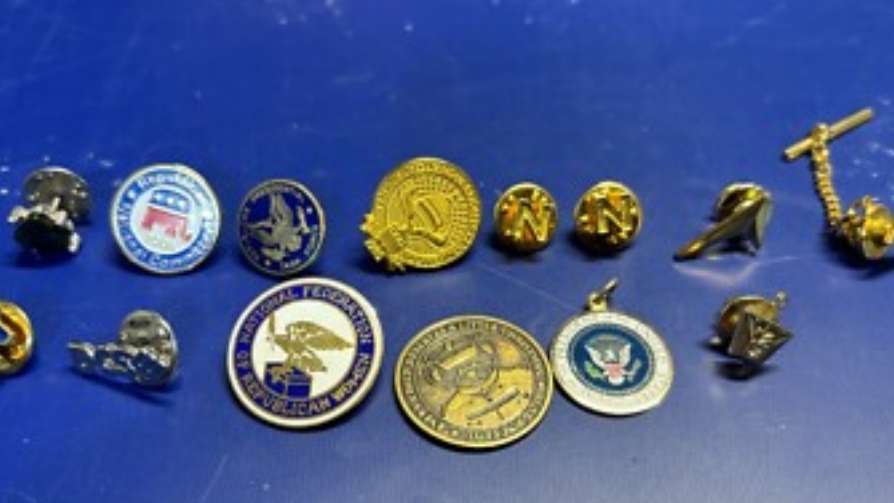
The most successful political pins of 2026 are not generic flag reproductions. Collectors, campaigns, and commemorative buyers are gravitating toward designs that tell a story or mark a specific moment. Based on manufacturer order books and retail best-seller lists, several design categories are dominating.
Founding-era iconography. The Liberty Bell paired with a “1776–2026” banner remains the single most requested Semiquincentennial motif. Variations include the Betsy Ross 13-star flag morphing into the modern 50-star flag — a visual shorthand for 250 years of evolution. “We the People” rendered in historical script, often with golden firework accents, is another strong seller, particularly for civic organizations and government gift shops.
Eagle and ribbon designs. The bald eagle clutching a “250 Years of Liberty” ribbon appeals to military and veteran audiences and crosses over into the campaign market, where eagles have long been a bipartisan symbol of strength.
State-specific editions. Texas 250, California 250, Virginia 250 — states with deep Revolutionary War connections or large anniversary programs are commissioning pins bearing their outlines alongside the Semiquincentennial branding. These function simultaneously as souvenirs, collector items, and local pride statements.
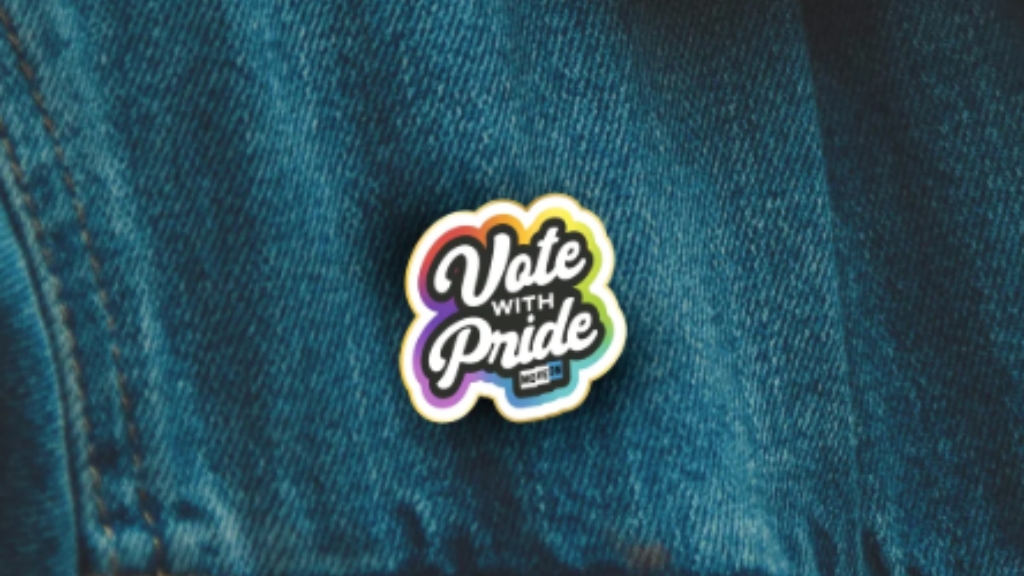
Campaign-era originals. On the electoral side, the trend is toward distinctive, brand-forward designs rather than the standard candidate-photo button. Minimalist wordmark pins, issue-specific pins (Second Amendment, environmental, voting rights), and co-branded pins created with allied organizations are all gaining traction. The goal is the same as in consumer branding: a pin that someone would wear even outside a rally.
Table 2: Top-Selling Political Pin Design Categories for 2026
Design Category | Key Visual Elements | Primary Market | Typical Price Range (Retail) |
Semiquincentennial — Founding Icons | Liberty Bell, “1776–2026,” Betsy Ross flag | Museums, parks, civic retail | 6–15 |
Semiquincentennial — Eagle & Ribbon | Bald eagle, “250 Years of Liberty” ribbon | Military, veteran orgs, government | 8–18 |
State-Specific 250th Editions | State outline + “250” + state colors | State parks, local gift shops, collectors | 7–14 |
Campaign Brand Pins | Candidate wordmark, campaign colors, slogan | Campaigns, volunteers, donors | 3–10 |
Issue / Cause Pins | Issue iconography (eagle, globe, ballot box) | Advocacy orgs, PACs, grassroots | 4–12 |
Commemorative Event Pins | Convention name, date, location, limited numbering | Delegates, event attendees, collectors | 10–25 |
Military Branch 250th | Branch insignia + “250” + service colors | Military exchanges, veteran groups | 8–20 |
The Economics of the Political Pin
The lapel pin sits at a sweet spot in the political merchandise economy: low enough in unit cost to distribute at scale, high enough in perceived value to serve as a fundraising incentive. A campaign ordering 10,000 soft enamel pins might pay 0.85–2.80 per unit at wholesale, then offer them to donors at a $15 suggested contribution — a markup that makes pins one of the most efficient fundraising tools in the political arsenal.
For the Semiquincentennial, the economics shift toward retail and commemorative channels. Museum gift shops, national park stores, and corporate gifting programs are ordering hard enamel pins with premium finishes — gold plating, magnet backs, velvet presentation boxes — at wholesale prices of 2–5 per unit and retail prices of 12–25. Limited-edition numbered runs, particularly those tied to specific events or institutions, are already showing secondary market appreciation, with convention-exclusive Semiquincentennial pins reselling at 50–200% premiums within weeks of release.
The broader lapel pin market — encompassing political, fandom, and vintage segments — is growing steadily, with political pins remaining a durable sub-segment that spikes predictably during election cycles. North America leads demand, driven by deeply rooted traditions of civic expression through wearable symbols. Vintage political pins from landmark elections — 1896 McKinley, 1932 Roosevelt, 1960 Kennedy — continue to appreciate among serious collectors, with authenticated pieces from notable campaigns carrying significant resale value. The 2026 cycle is expected to produce its own generation of future vintage: a delegate pin from a contested convention, a limited Semiquincentennial edition from a national park, or a campaign pin from a surprise upset could all be collector’s items within a decade.
Table 3: Pin Formats for Political and Commemorative Use
Format | Production Cost (Wholesale) | Best For | Durability | Perceived Value |
Soft Enamel | 0.85–2.80 | High-volume campaign distribution | Good | Medium |
Hard Enamel | 1.50–4.00 | Commemorative retail, premium gifts | Excellent | High |
Die-Struck (No Color) | 1.20–3.50 | Formal / government / military | Excellent | High |
Printed / Offset | 0.45–1.50 | Budget campaigns, events | Moderate | Low–Medium |
3D / Multi-Layer | 3.00–6.00 | Collector editions, VIP gifts | Excellent | Very High |
Who's Buying — and Why It Matters
The 2026 political pin market is not a single audience. It is at least four distinct buyer segments, each with different motivations, price points, and design preferences.
Campaigns and political organizations are the volume drivers. They need pins that are affordable, durable, and instantly recognizable — tools for visibility and solidarity at rallies, door-knocks, and town halls. For them, the pin is a communication device, not a keepsake.
Civic and commemorative institutions — museums, national parks, historical societies, the America 250 Foundation’s partner organizations — want pins that honor the moment with craftsmanship. They favor hard enamel, die-struck metal, and premium packaging. Their customers are buying a memory, and they expect the object to last.
Collectors and enthusiasts are the segment that gives the market long-tail value. They hunt limited editions, numbered runs, convention exclusives, and error variants. They are the reason a 12 retail pin can become a 60 resale within weeks. For manufacturers, courting this segment means investing in serialization, certificates of authenticity, and designs that reward close inspection.
Corporate and organizational buyers — companies marking their own anniversaries in 2026, chambers of commerce, universities celebrating the Class of 2026 — want pins that bridge civic pride and institutional branding. A company founded in 1976, for instance, can mark 50 years alongside the nation’s 250th, and a co-branded pin makes that connection tangible.
What unites all four segments is the same insight that has driven political pins since Nixon’s era: in a world saturated with digital messaging, a small piece of metal worn over the heart carries a signal that no algorithm can replicate. It says, I was here. I believed in this. I was part of this moment.
The Renaissance Is Here
The political lapel pin has survived Civil War divisions, Vietnam-era protests, post-9/11 uniformity, and the social media age. It has endured because it solves a problem that no other medium solves quite as well: it lets an individual make a public, physical, and durable statement of identity and allegiance at a scale that a human body can carry.
In 2026, that function matters more than it has in decades. A midterm election asks Americans to choose a direction. A 250th anniversary asks them to reflect on where they’ve been. The lapel pin — affordable, visible, collectible, personal — is the one object that can hold both questions at once. Whether it is a campaign volunteer pinning a candidate’s wordmark before a Saturday canvas, a family buying a Liberty Bell edition at a national park, or a collector tracking down a numbered convention exclusive, the act is the same: turning a moment into something you can hold.
The renaissance isn’t coming. It’s already on the lapel.